Page 586 - Dynamics of Mechanical Systems
P. 586
0593_C16_fm  Page 567  Tuesday, May 7, 2002  7:06 AM


                       Mechanical Components: Cams                                                 567


                                                                                       Dwell


                                                               Dwell

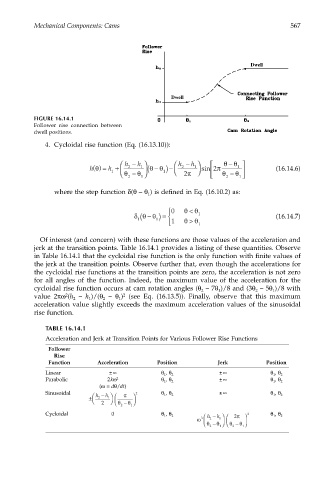
                       FIGURE 16.14.1
                       Follower rise connection between
                       dwell positions.
                          4. Cycloidal rise function (Eq. (16.13.10)):

                                                                                −
                                       h θ () = h +   h −  h  ( θθ ) −   h −  h   sin  2 π  θθ   (16.14.6)
                                                          −
                                                   2
                                                      1
                                                                      1
                                                                                   1
                                                                  2
                                              1    θ −  θ   1    2 π      θ − θ  1  
                                                   2
                                                      1
                                                                                2
                             where the step function δ(θ – θ ) is defined in Eq. (16.10.2) as:
                                                        1
                                                     1(
                                                        −
                                                    δθ θ ) =  0   θ <  θ 1                  (16.14.7)
                                                           1
                                                               1  θ >  θ 1
                        Of interest (and concern) with these functions are those values of the acceleration and
                       jerk at the transition points. Table 16.14.1 provides a listing of these quantities. Observe
                       in Table 16.14.1 that the cycloidal rise function is the only function with finite values of
                       the jerk at the transition points. Observe further that, even though the accelerations for
                       the cycloidal rise functions at the transition points are zero, the acceleration is not zero
                       for all angles of the function. Indeed, the maximum value of the acceleration for the
                       cycloidal rise function occurs at cam rotation angles (θ  – 7θ )/8 and (3θ  – 5θ )/8 with
                                                                             1
                                                                                        2
                                                                        2
                                                                                             1
                       value 2πω (h   –  h )/(θ   –  θ )  (see Eq. (16.13.5)). Finally, observe that this maximum
                                2
                                                 2
                                                1
                                       1
                                           2
                                  2
                       acceleration value slightly exceeds the maximum acceleration values of the sinusoidal
                       rise function.
                          TABLE 16.14.1
                          Acceleration and Jerk at Transition Points for Various Follower Rise Functions
                           Follower
                             Rise
                           Function      Acceleration      Position          Jerk           Position
                          Linear             ±∞             θ 1 , θ 2         ±∞             θ 1 , θ 2
                          Parabolic         2kω   2         θ 1 , θ 2         ±∞             θ 1 , θ 2
                                          (ω = dθ/dt)
                          Sinusoidal       − h     π    2  θ 1 , θ 2       ±∞             θ 1 , θ 2
                                       ±  h 2  2  1     θ 2  − θ  1  
                                        
                          Cycloidal           0             θ 1 , θ 2   3 h −  h   π   2    θ 1 , θ 2
                                                                              1  
                                                                         
                                                                                  2
                                                                       ω     θ − θ   θ − θ  
                                                                           2
                                                                               
                                                                                    1
                                                                                  2
                                                                              1
                                                                           2
   581   582   583   584   585   586   587   588   589   590   591