


Page 583 - Dynamics of Mechanical Systems
P. 583
0593_C16_fm  Page 564  Tuesday, May 7, 2002  7:06 AM


                       564                                                 Dynamics of Mechanical Systems


                       and then from Eq. (16.13.1) we have:

                                               x =  r(θ sin  ) θ  and  y = (1  ) θ            (16.13.6)
                                                     −
                                                                     r − cos
                        Equations (16.13.6) are parametric equations of a cycloid with θ being the parameter.
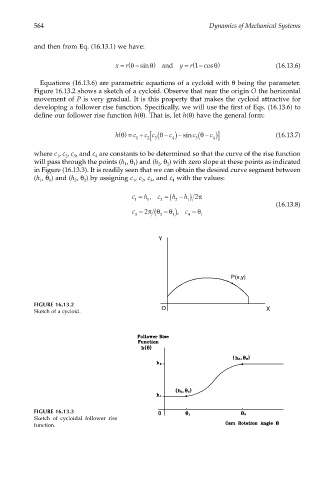
                       Figure 16.13.2 shows a sketch of a cycloid. Observe that near the origin O the horizontal
                       movement of P is very gradual. It is this property that makes the cycloid attractive for
                       developing a follower rise function. Specifically, we will use the first of Eqs. (16.13.6) to
                       define our follower rise function h(θ). That is, let h(θ) have the general form:

                                                                       (
                                               h θ () =  c +  c c θ − ) − sin c θ − )]        (16.13.7)
                                                                           c
                                                               c
                                                     1  2  ( [ 3  4    3    4
                       where c , c , c , and c  are constants to be determined so that the curve of the rise function
                                2
                                  3
                                         4
                             1
                       will pass through the points (h , θ ) and (h , θ ) with zero slope at these points as indicated
                                                    1
                                                 1
                                                           2
                                                              2
                       in Figure (16.13.3). It is readily seen that we can obtain the desired curve segment between
                       (h , θ ) and (h , θ ) by assigning c , c , c , and c  with the values:
                                     2
                                                                4
                           1
                                   2
                                                       2
                                                         3
                        1
                                                    1
                                                    c =  h ,  c = ( h − )  2π
                                                                   h
                                                     1  1   2    2  1
                                                                                              (16.13.8)
                                                    c = 2πθ 2 (  − θ  c = θ
                                                     3          1),  4  1
                                                            Y
                                                                                 P(x,y)
                       FIGURE 16.13.2                        O
                       Sketch of a cycloid.                                                 X


                       FIGURE 16.13.3
                       Sketch of cycloidal follower rise
                       function.

