Page 581 - Dynamics of Mechanical Systems
P. 581
0593_C16_fm  Page 562  Tuesday, May 7, 2002  7:06 AM


                       562                                                 Dynamics of Mechanical Systems


                                                                                                     2
                                                                                                2
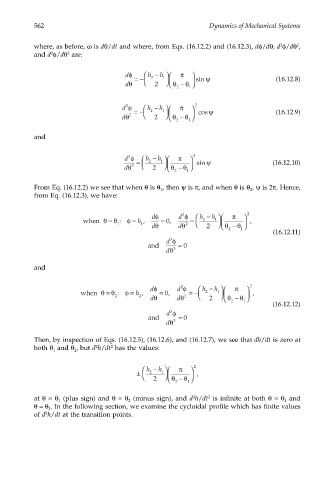
                       where, as before, ω is dθ/dt and where, from Eqs. (16.12.2) and (16.12.3), dφ/dθ, d φ/dθ ,
                                 3
                            3
                       and d φ/dθ  are:
                                                  dφ  =−  h −  h   π    ψ
                                                             1
                                                         2
                                                  dθ      2     θ −  θ    sin           (16.12.8)
                                                                 2
                                                                     1
                                                 d φ  =−  h −  h   π    2  ψ
                                                  2
                                                             1
                                                         2
                                                 dθ 2    2      θ − θ 1    cos          (16.12.9)
                                                                 2
                       and

                                                  d φ  =  h −  h   π    3  ψ
                                                   3
                                                            1
                                                         2
                                                 dθ 3    2     θ − θ 1    sin          (16.12.10)
                                                                2
                       From Eq. (16.12.2) we see that when θ is θ , then ψ is π, and when θ is θ , ψ is 2π. Hence,
                                                                                       2
                                                            1
                       from Eq. (16.12.3), we have:
                                             =
                                     when θθ    : φ = h  ,  d φ  =  , 0  d 2 φ  =   h 2  − h 1    π     2 ,
                                               1      1    θ       θ 2        θ −  θ 
                                                          d       d       2     2  1
                                                                                              (16.12.11)
                                                              d 3 φ
                                                        and     3  = 0
                                                              d θ
                       and


                                            =
                                    when θθ    : φ = h  ,  d φ  =  , 0  d 2 φ  = −  h 2  − h 1    π     2 ,
                                               2      2   θ       θ 2          θ −  θ 
                                                         d       d         2     2  1
                                                                                             (16.12.12)
                                                              d 3 φ
                                                        and     3  = 0
                                                              d θ
                       Then, by inspection of Eqs. (16.12.5), (16.12.6), and (16.12.7), we see that dh/dt is zero at
                                         2
                       both θ  and θ , but d h/dt  has the values:
                                             2
                            1
                                   2
                                                     ±   h 2  − h 1     π     2 ,
                                                         2   θ  2  − θ 1 
                                                              
                                                                      3
                                                                          3
                       at θ = θ  (plus sign) and θ = θ  (minus sign), and d h/dt  is infinite at both θ = θ  and
                                                   2
                                                                                                 1
                              1
                       θ = θ . In the following section, we examine the cycloidal profile which has finite values
                           2
                       of d h/dt at the transition points.
                          3
   576   577   578   579   580   581   582   583   584   585   586