


Page 580 - Dynamics of Mechanical Systems
P. 580
0593_C16_fm Page 561 Tuesday, May 7, 2002 7:06 AM
Mechanical Components: Cams 561
Follower
Rise
h(θ)
h
2
cosine
Rise
Segment
h
1
θ
FIGURE 16.12.2 θ 1 θ 2
Fitting a cosine segment to obtain a
desired follower rise. Cam Rotation Angle
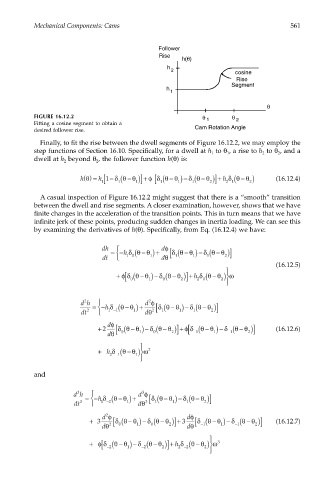
Finally, to fit the rise between the dwell segments of Figure 16.12.2, we may employ the
step functions of Section 16.10. Specifically, for a dwell at h to θ , a rise to h to θ , and a
1
2
1
2
dwell at h beyond θ , the follower function h(θ) is:
2
2
δ θθ )]
[
δ θ θ )]
(
−
−
h θ () = h 1 − ( − + φ δ θθ ) − ( − + h δ θθ ) (16.12.4)
1 1 1 ( [ 1 1 1 2 2 1 2
A casual inspection of Figure 16.12.2 might suggest that there is a “smooth” transition
between the dwell and rise segments. A closer examination, however, shows that we have
finite changes in the acceleration of the transition points. This in turn means that we have
infinite jerk of these points, producing sudden changes in inertia loading. We can see this
by examining the derivatives of h(θ). Specifically, from Eq. (16.12.4) we have:
dh h ( dφ − )]
=− δθ − ) +θ δθ θ δ
− ) − (θ θ
dt 10 1 dθ ( [ 1 1 1 2
(16.12.5)
h (θ θ
− ) − (θ θ
+ φδ θ θ δ − )] + δ − ) ω
0
2 0
2
1
2
( [ 0
2
2
dh =− h δ − 1) + d φ 2[ δθ − θ 1) − (θ θ 2)]
1(
δ
1 (θ θ
−
dt 2 − 1 dθ 1
dφ
0( [
−
−
δ
−
δ
+ 2 δ θ − θ 1) − (θθ + φ δ 1(θθ 1) − (θ θ 2)] (16.12.6)
dθ 0 2)] [ − − 1
2 (θ θ
+ h δ − 1 − 1) ω 2
and
3
3
dh =− h δ − 1) + d φ 3[ δθ − θ 1) − (θ θ 2)]
1(
δ
−
1 (θ θ
dt 3 − 2 dθ 1
d φ dφ
2
0(
δ
−
−
+ 3 2[ δθ − θ 1) − (θ θ 2)] + 3 δ 1(θ θ 1) − (θ θ 2)] (16.12.7)
−
δ
dθ 0 dθ [ − − 1
+ φδ − [ 2(θ θ 1) − δ ( θ θθ )] + h δ ( θ θ ) ω 3
−
−
−
−
−2
2
2
2
2


