


Page 575 - Dynamics of Mechanical Systems
P. 575
0593_C16_fm Page 556 Tuesday, May 7, 2002 7:06 AM
556 Dynamics of Mechanical Systems
δ (x - a)
-1
δ (x - a)
0
0 a x
0 a x
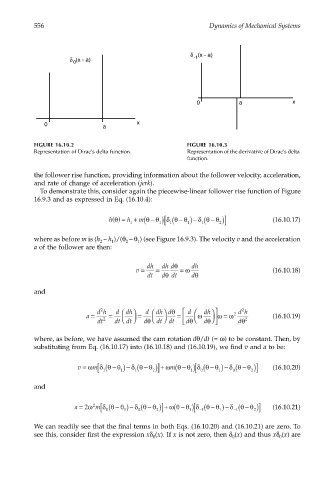
FIGURE 16.10.2 FIGURE 16.10.3
Representation of Dirac’s delta function. Representation of the derivative of Dirac’s delta
function.
the follower rise function, providing information about the follower velocity, acceleration,
and rate of change of acceleration (jerk).
To demonstrate this, consider again the piecewise-linear follower rise function of Figure
16.9.3 and as expressed in Eq. (16.10.4):
δ θ θ )]
h θ () = h + ( − δ θ θ ) − ( − (16.10.17)
−
1 m θ θ ) ( [ 1 1 1 2
1
where as before m is (h – h )/(θ – θ ) (see Figure 16.9.3). The velocity v and the acceleration
1
2
1
2
a of the follower are then:
v = dh = dh dθ = ω dh (16.10.18)
θ
dt d dt dθ
and
2
2
a = dh = d dh = d dh dθ = d ω dh ω = ω 2 dh (16.10.19)
d
θ
θ
dt 2 dt dt d dt dt θ d dθ 2
where, as before, we have assumed the cam rotation dθ/dt (= ω) to be constant. Then, by
substituting from Eq. (16.10.17) into (16.10.18) and (16.10.19), we find v and a to be:
− ) − (θ θ
v = ω δ θθ δ − )] + ω m(θθ δ θ θ δ − )] (16.10.20)
− ) − (θθ
1
m ( [ 1
1 1 2 − ) ( [ 0 1 0 2
and
− )]
θ
δ θθ
− )] + (θθ δ
δ
a = 2ω 2 m ( [ 0 − ) − (θ θ 2 ω − )[ −1 (θ − ) − δ −1 (θθ 2 (16.10.21)
0
1
1
1
We can readily see that the final terms in both Eqs. (16.10.20) and (16.10.21) are zero. To
see this, consider first the expression xδ (x). If x is not zero, then δ (x) and thus xδ (x) are
0
0
0

