Page 584 - Dynamics of Mechanical Systems
P. 584
0593_C16_fm  Page 565  Tuesday, May 7, 2002  7:06 AM


                       Mechanical Components: Cams                                                 565


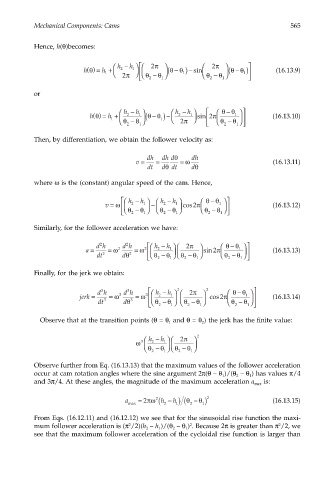
                       Hence, h(θ)becomes:


                                     h θ () =  h +  h − h       2 π  ( θθ ) − sin    2 π  ( θθ )    (16.13.9)
                                                                −
                                                                                  −
                                                    1
                                                2
                                            1
                                               2 π    θ −  θ   1     θ − θ    1  
                                                         2
                                                            1
                                                                               1
                                                                           2
                       or
                                                                                −
                                                 h −  h       h −  h       θθ  
                                       h θ () =  h +  2  1 ( θθ ) −  2  1  sin  2 π  1      (16.13.10)
                                                          −
                                             1    θ −  θ   1   2 π        θ − θ   
                                                                                   1
                                                      1
                                                                               2
                                                  2
                       Then, by differentiation, we obtain the follower velocity as:
                                                     v =  dh  =  dh dθ  = ω  dh               (16.13.11)
                                                              θ
                                                        dt   d dt    dθ
                       where ω is the (constant) angular speed of the cam. Hence,
                                                    h −  h     h −  h    θθ   
                                                                           −
                                            v = ω     2  1   −   2  1   cos 2 π   1     (16.13.12)
                                                   θ 2  − θ 1    θ 2 − θ 1    θ 2  − θ 1  
                       Similarly, for the follower acceleration we have:

                                                                                 −
                                          2
                                                  2
                                      a =  dh  = ω 2  dh  = ω 2       h −  h    2π     sin 2π  θθ 1     (16.13.13)
                                                               1
                                                           2
                                                                              
                                                                 
                                                                                      
                                         dt 2    dθ 2     θ 2 − θ 1   θ 2  − θ 1    θ 2  − θ 1  
                       Finally, for the jerk we obtain:
                                                                 2
                                                                                   −
                                                  3
                                           3
                                    jerk =  dh  = ω  3  dh  = ω  3      h −  h    2π     2  cos 2π  θθ 1       (16.13.14)
                                                               1
                                                            2
                                                                 
                                                                                
                                          dt 3   dθ 3        θ 2  − θ 1   θ 2  − θ 1    θ  2 − θ 1   
                        Observe that at the transition points (θ = θ  and θ = θ ) the jerk has the finite value:
                                                                        2
                                                               1
                                                     ω 3    h −  h 1    2 π    2
                                                               
                                                          2
                                                        θ −  θ   θ − θ 
                                                                 2
                                                          2
                                                                     1
                                                             1
                       Observe further from Eq. (16.13.13) that the maximum values of the follower acceleration
                       occur at cam rotation angles where the sine argument 2π(θ – θ )/(θ  – θ ) has values π/4
                                                                               1
                                                                                       1
                                                                                   2
                       and 3π/4. At these angles, the magnitude of the maximum acceleration a max  is:
                                                                        θ
                                                  a   = 2πω  2  h   θ  − ) 2                 (16.13.15)
                                                            h − ) ( 2
                                                   max      ( 2  1       1
                       From Eqs. (16.12.11) and (16.12.12) we see that for the sinusoidal rise function the maxi-
                                                                                               2
                                                   2
                                                                     2
                       mum follower acceleration is (π /2)(h  – h )/(θ  – θ ) . Because 2π is greater than π /2, we
                                                            1
                                                        2
                                                                    1
                                                                2
                       see that the maximum follower acceleration of the cycloidal rise function is larger than
   579   580   581   582   583   584   585   586   587   588   589