


Page 166 - Electrical Installation in Hazardous Area
P. 166
132  Electrical installations in hazardous areas


                                    Hip


                                           Ground
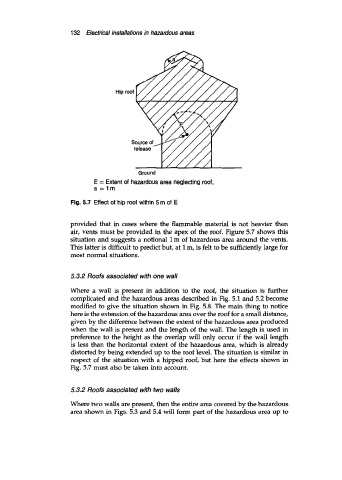
                              E = Extent of hazardous area neglecting roof,
                              a=lm

                      Fig. 5.7  Effect of  hip roof within 5m of  E


                      provided that in cases where the flammable material is not heavier than
                      air, vents must be provided in the apex of  the roof. Figure 5.7 shows this
                      situation and suggests a notional 1 m of  hazardous area around the vents.
                      This latter is difficult to predict but, at 1 m, is felt to be sufficiently large for
                      most normal situations.


                      5.3.2 Roofs associated with one wall

                      Where  a  wall is present in addition to  the  roof,  the  situation is further
                      complicated and the hazardous areas described in Fig. 5.1 and 5.2 become
                      modified to give the situation shown in Fig. 5.8. The main thing to notice
                      here is the extension of the hazardous area over the roof for a small distance,
                      given by the difference between the extent of  the hazardous area produced
                      when the wall is present and the length of  the wall. The length is used in
                      preference to the height as the overlap will only occur if  the wall length
                      is less than the horizontal extent of  the hazardous area, which is already
                      distorted by being extended up to the roof  level. The situation is similar in
                      respect of  the situation with a hipped roof, but here the effects shown in
                      Fig. 5.7 must also be taken into account.


                      5.3.2 Roofs associated with two walls
                      Where two walls are present, then the entire area covered by the hazardous
                      area shown in Figs. 5.3 and 5.4 will form part of  the hazardous area up to

