


Page 168 - Electrical Installation in Hazardous Area
P. 168
1 34  Electrical installations in hazardous areas


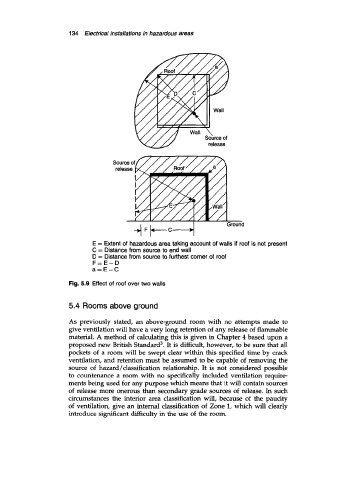
                             E = Extent of  hazardous area taking account of  walls if  roof is not present
                             C = Distance from source to end wall
                             D = Distance from source to furthest corner of  roof
                             F=E-D
                             a=E-C

                      Fig. 5.9  Effect of  roof over two walls


                      5.4 Rooms above ground

                      As  previously stated, an above-ground room  with no  attempts made  to
                      give ventilation will have a very long retention of  any release of  flammable
                      material. A method of  calculating this is given in Chapter 4 based upon a
                      proposed new British Standard3. It is difficult, however, to be sure that all
                      pockets of  a room will be swept clear within this specified time by crack
                      ventilation, and retention must be assumed to be capable of  removing the
                      source of  hazard/classification relationship. It  is not considered possible
                      to  countenance a  room  with no specifically included ventilation require-
                      ments being used for any purpose which means that it will contain sources
                      of  release more onerous than secondary grade sources of  release. In such
                      circumstances the interior area classification will, because of  the paucity
                      of  ventilation, give an internal classification of  Zone 1, which will clearly
                      introduce significant difficulty in the use of  the room.

