


Page 169 - Electrical Installation in Hazardous Area
P. 169
Area classification in areas which are not  freely ventilated  135


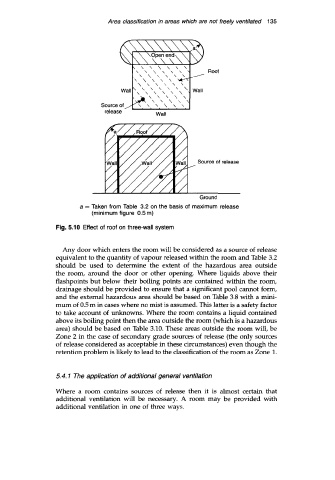
                                                                Roof


                                                             Ground
                         a = Taken from Table  3.2 on the basis of maximum release
                             (minimum figure  0.5 m)

                  Fig. 5.10  Effect of  roof on three-wall system


                    Any door which enters the room will be considered as a source of  release
                  equivalent to the quantity of  vapour released within the room and Table 3.2
                  should  be  used  to  determine  the  extent  of  the  hazardous  area  outside
                  the room, around  the  door  or  other opening. Where liquids above their
                  flashpoints but below  their boiling points are contained within the room,
                  drainage should be provided to ensure that a significant pool cannot form,
                  and the external hazardous area should be based on Table 3.8 with a mini-
                  mum of  0.5 m in cases where no mist is assumed. This latter is a safety factor
                  to take account of  unknowns. Where the room contains a liquid contained
                  above its boiling point then the area outside the room (which is a hazardous
                  area) should be based on Table 3.10. These areas outside the room will, be
                  Zone 2 in the case of  secondary grade sources of  release (the only sources
                  of  release considered as acceptable in these circumstances) even though the
                  retention problem is likely to lead to the classification of the room as Zone 1.


                  5.4.1 The application of additional general ventilation

                  Where  a  room  contains sources of  release  then  it  is  almost certain that
                  additional ventilation will  be  necessary. A  room  may  be  provided  with
                  additional ventilation in one of  three ways.

