


Page 175 - Electrical Installation in Hazardous Area
P. 175
Area classification in areas which are not freely ventilated  141


                         (Note


                                 Continubus grade
                                 source of release
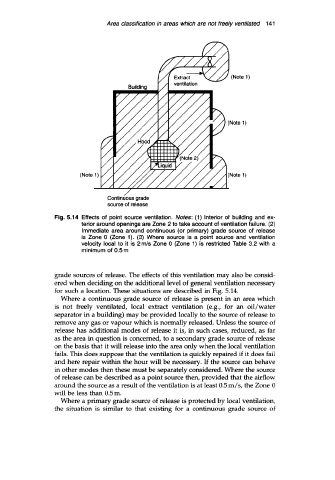
                  Fig. 5.14  Effects of  point source ventilation. Notes: (1) Interior of  building and ex-
                          terior around openings are Zone 2 to take account of ventilation failure. (2)
                          Immediate area around continuous (or primary) grade source of  release
                          is  Zone 0 (Zone 1). (3) Where source  is  a  point source and ventilation
                          velocity local to it  is 2m/s Zone 0 (Zone 1)  is restricted Table 3.2 with  a
                          minimum of 0.5 m


                  grade sources of  release. The effects of  tlus ventilation may also be consid-
                 ered when deciding on the additional level of  general ventilation necessary
                  for such a location. These situations are described in Fig. 5.14.
                   Where a continuous grade source of  release is present in an area which
                  is  not  freely  ventilated,  local  extract  ventilation  (e.g.,  for  an  oil/water
                  separator in a building) may be provided locally to the source of  release to
                 remove any gas or vapour which is normally released. Unless the source of
                  release has additional modes of  release it is, in such cases, reduced, as far
                 as the area in question is concerned, to a secondary grade source of  release
                  on the basis that it will release into the area only when the local ventilation
                 fails. This does suppose that the ventilation is quickly repaired if  it does fail
                 and here repair within the hour will be necessary. If  the source can behave
                 in other modes then these must be separately considered. Where the source
                 of  release can be described as a point source then, provided that the airflow
                 around the source as a result of  the ventilation is at least 0.5 m/s, the Zone 0
                 will be less than 0.5m.
                   Where a primary grade source of  release is protected by local ventilation,
                 the situation is similar to  that  existing for a  continuous grade source of

