


Page 178 - Electrical Installation in Hazardous Area
P. 178
144  Electrical installations in hazardous areas


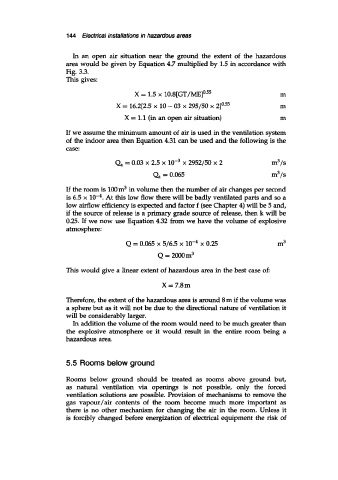
                       In an open air  situation near  the ground the  extent of  the hazardous
                     area would be given by Equation 4.7 multiplied by 1.5 in accordance with
                     Fig. 3.3.
                     This gives:

                                          X = 1.5 x 10.8[GT/ME]o.55                   m
                                    X = 16.2[2.5 x 10 - 03 x 295/50 x 2]0,55          m

                                       X = 1.1 (in an open air situation)             m
                     If  we assume the minimum amount of  air is used in the ventilation system
                     of  the indoor area then Equation 4.31 can be used and the following is the
                     case:

                                    Q = 0.03 x 2.5 x    x 2952150 x 2              m3/s
                                               Q, = 0.065                          m3/s

                     If  the room is 100 m3 in volume then the number of  air changes per second
                     is 6.5 x    At this low flow there will be badly ventilated parts and so a
                     low airflow efficiency is expected and factor f (see Chapter 4) will be 5 and,
                     if the source of  release is a primary grade source of  release, then k will be
                     0.25. If  we now use Equation 4.32  from we have the volume of  explosive
                     atmosphere:

                                       Q = 0.065 x 516.5 x    x 0.25                 m3

                                                 Q = 2000111~
                     This would give a linear extent of  hazardous area in the best case of:

                                                  X = 7.8m

                     Therefore, the extent of  the hazardous area is around 8 m if  the volume was
                     a sphere but as it will not be due to the directional nature of  ventilation it
                     will be considerably larger.
                       In addition the volume of  the room would need to be much greater than
                     the explosive atmosphere or  it would  result  in  the entire room being  a
                     hazardous area.


                     5.5 Rooms below ground

                     Rooms below  ground  should  be  treated  as  rooms  above  ground  but,
                     as  natural  ventilation  via  openings  is  not  possible,  only  the  forced
                     ventilation solutions are possible. Provision of mechanisms to remove the
                     gas vapour/air  contents of  the  room  become  much  more  important as
                     there is no other mechanism for changing the air in the room. Unless it
                     is forcibly changed before energization of  electrical equipment the risk of

