


Page 403 - Electrical Properties of Materials
P. 403
The Landau–Ginzburg theory                         385
                                                             2
                                                  1      dA


                                              4
                                        2
                         G s (B)= G n + a 1 ψ + a 2 ψ +  B a –
                                                 μ 0     dx
                                               2
                                   1   2  ∂ψ       2 2  2
                                +               +4e A ψ   .          (14.52)
                                  2m       ∂x
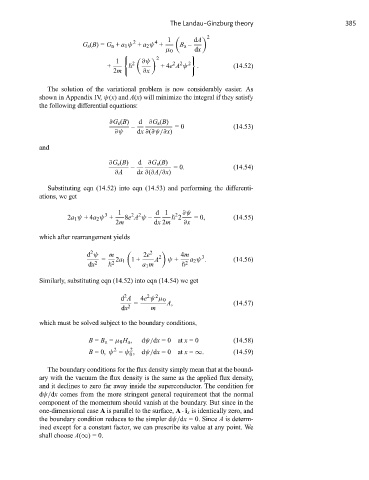
               The solution of the variational problem is now considerably easier. As
            shown in Appendix IV, ψ(x) and A(x) will minimize the integral if they satisfy
            the following differential equations:
                                 ∂G s (B)  d ∂G s (B)
                                       –            = 0              (14.53)
                                  ∂ψ     dx ∂(∂ψ/∂x)
            and

                                 ∂G s (B)  d ∂G s (B)
                                       –           = 0.              (14.54)
                                  ∂A     dx ∂(∂A/∂x)

               Substituting eqn (14.52) into eqn (14.53) and performing the differenti-
            ations, we get

                                   1   2 2    d 1   2  ∂ψ
                               3
                     2a 1 ψ +4a 2 ψ +  8e A ψ –      2   = 0,        (14.55)
                                   2m         dx 2m   ∂x
            which after rearrangement yields

                           2
                          d ψ    m         2e 2  2     4m   3
                               =   2a 1 1+    A   ψ +   a 2 ψ .      (14.56)
                           dx 2    2      a 1 m         2
            Similarly, substituting eqn (14.52) into eqn (14.54) we get

                                     2
                                            2
                                              2
                                    d A   4e ψ μ 0
                                        =        A,                  (14.57)
                                    dx 2     m
            which must be solved subject to the boundary conditions,
                           B = B a = μ 0 H a ,  dψ/dx =0  at x = 0   (14.58)
                                  2
                                       2
                           B =0, ψ = ψ ,  dψ/dx =0   at x = ∞.       (14.59)
                                       0
               The boundary conditions for the flux density simply mean that at the bound-
            ary with the vacuum the flux density is the same as the applied flux density,
            and it declines to zero far away inside the superconductor. The condition for
            dψ/dx comes from the more stringent general requirement that the normal
            component of the momentum should vanish at the boundary. But since in the
            one-dimensional case A is parallel to the surface, A · i x is identically zero, and
            the boundary condition reduces to the simpler dψ/dx = 0. Since A is determ-
            ined except for a constant factor, we can prescribe its value at any point. We
            shall choose A(∞)=0.

