


Page 208 - Engineering Digital Design
P. 208
4.9 FACTORIZATION, RESUBSTITUTION, AND DECOMPOSITION METHODS        179


                    As a practical example of the application of Shannon's expansion theorem, consider the
                  function
                                 F(A, B, C, D) = ^m(l, 3, 4, 5, 9, 10, 13, 14,15),   (4.71)

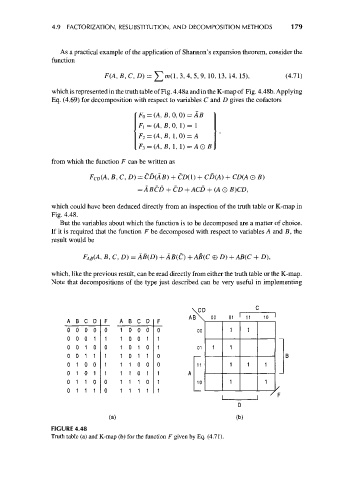
                  which is represented in the truth table of Fig. 4.48a and in the K-map of Fig. 4.48b. Applying
                  Eq. (4.69) for decomposition with respect to variables C and D gives the cofactors
                                           F 0 = (A, B,Q,Q)=AB
                                           F) = (A, 5,0, 1)= 1
                                           F 2 = (A, B, 1,0) = A
                                          F 3 = (A,B,l,l)=AQB\

                  from which the function F can be written as
                             F CD(A, B, C, D) = CD(AB) + CD(1) + CD(A) + CD(A Q B)

                                          = ABCD + CD + ACD + (A 0 B)CD,

                  which could have been deduced directly from an inspection of the truth table or K-map in
                  Fig. 4.48.
                    But the variables about which the function is to be decomposed are a matter of choice.
                  If it is required that the function F be decomposed with respect to variables A and B, the
                  result would be

                           F AB(A, B, C, D) = AB(D)+AB(C)+AB(C 0 D) + AB(C + D),

                  which, like the previous result, can be read directly from either the truth table or the K-map.
                  Note that decompositions of the type just described can be very useful in implementing


                                                          VCD               °
                                                               00   01   11   10
                                                         AB
                      A B C D    F   A B C D    F           \
                      000 0      0   100    0   0          00        1    1
                      000 1      1   100 1      1
                      001 0      0   101 0      1          01   1    1
                      001 1      1   101 1      0
                      010 0      1   110 0      0          11        1    1    1
                      010 1      1 110 1        1        A
                      011 0      0 111 0        1          10        1         1
                      011 1      0   111 1      1                                 /
                                                                                / F


                                  (a)                                 (b)
                  FIGURE 4.48
                 Truth table (a) and K-map (b) for the function F given by Eq. (4.71).

