


Page 209 - Engineering Digital Design
P. 209
180          CHAPTER 4 /LOGIC FUNCTION REPRESENTATION AND MINIMIZATION


                    functions of a large number of variables by using devices with lesser input capability. The
                    use of multiplexers discussed in Section 6.2 offers a good example of this fact.
                      The process of decomposition can be reversed to yield a purely SOP or purely POS
                    expression from the decomposed expression. This is illustrated by factoring out A, A, B,
                    and B in turn from F AB to yield the SOP expression


                                 F AB = AB(D) + A B(C) + AB(C 0 £>) + AB(C + D)
                                     = A [BD + BC] + A[B(C 0 D) + B(C + D)]
                                     = AB[D]+AB[C] +AB[CD + CD] + AB[C + D]
                                     = ABD+ABC+ABCD


                    where C © D = CD + CD follows from Eq. (3.4). A cursory inspection of the SOP form
                    of F AB verifies its agreement with Fig. 4.48.


                    4.10 DESIGN AREA VS PERFORMANCE

                    It is common to observe an inverse relationship between design area and performance
                    (delay). That is, circuit realizations with improved design area commonly suffer from
                    poorer performance and vice versa. It is known that CMOS gate performance decreases
                    (i.e., delay increases) with increasing numbers of inputs (fan-in). The larger the fan-in,
                    the greater is the path delay through the gate. As an example, consider the function of
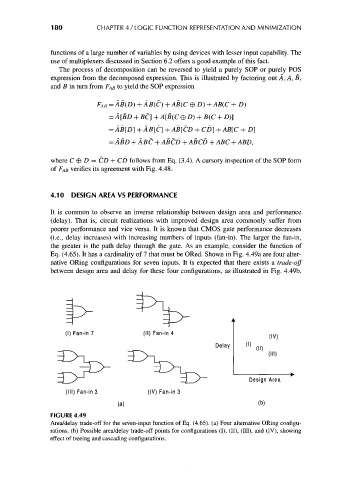
                    Eq. (4.65). It has a cardinality of 7 that must be ORed. Shown in Fig. 4.49a are four alter-
                    native ORing configurations for seven inputs. It is expected that there exists a trade-off
                    between design area and delay for these four configurations, as illustrated in Fig. 4.49b.


                        (I) Fan-in 7           (II) Fan-in 4
                                                                                   (IV)
                                                                   Delay    (I)
                                                                               (II)


                                                                             Design Area
                         (III) Fan-in 3         (IV) Fan-in 3
                                       (a)                                     (b)
                    FIGURE 4.49
                    Area/delay trade-off for the seven-input function of Eq. (4.65). (a) Four alternative ORing configu-
                    rations, (b) Possible area/delay trade-off points for configurations (I), (II), (III), and (IV), showing
                    effect of treeing and cascading configurations.

