


Page 211 - Engineering Digital Design
P. 211
182          CHAPTER 4 / LOGIC FUNCTION REPRESENTATION AND MINIMIZATION


                                                            VBC
                                                           A\  oo   01 ' 11   10
                                                                     1
                                                                       1
                                                           •E


                                          c                            c
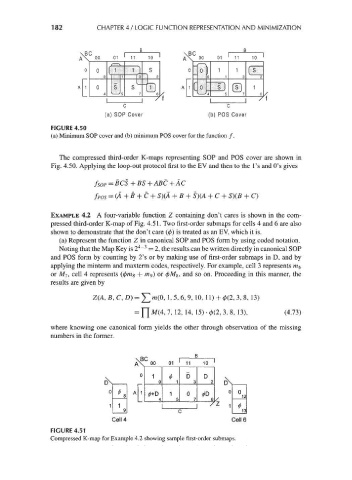
                                     (a) SOP Cover                (b) POS Cover
                    FIGURE 4.50
                    (a) Minimum SOP cover and (b) minimum POS cover for the function /.


                      The compressed third-order K-maps representing SOP and POS cover are shown in
                    Fig. 4.50. Applying the loop-out protocol first to the EV and then to the 1's and O's gives

                                fsop = BCS +BS+ ABC + AC
                                                         B + S)(A + C + S)(B + C)


                    EXAMPLE 4.2 A four-variable function Z containing don't cares is shown in the com-
                    pressed third-order K-map of Fig. 4.51. Two first-order submaps for cells 4 and 6 are also
                    shown to demonstrate that the don't care (0) is treated as an EV, which it is.
                      (a) Represent the function Z in canonical SOP and POS form by using coded notation.
                                             4 3
                      Noting that the Map Key is 2 ~  = 2, the results can be written directly in canonical SOP
                    and POS form by counting by 2's or by making use of first-order submaps in D, and by
                    applying the minterm and maxterm codes, respectively. For example, cell 3 represents m^
                    or M-j, cell 4 represents (0m 8 + mg) or 0Mg, and so on. Proceeding in this manner, the
                    results are given by
                                Z(A, B, C, D) = ^m(0, 1,5,6,9, 10, 11) + 0(2, 3, 8, 13)

                                            = Y[ M(4, 7, 12, 14, 15) • 0(2, 3, 8, 13),  (4.73)

                    where knowing one canonical form yields the other through observation of the missing
                    numbers in the former.


                                             vBC
                                                00    01 ' 11  10
                                                 1  0   1  D  3  D  2
                                            f   ^+D 4  * 1  5  0  7  *D 6


                                     Cell 4                             Cell 6
                    FIGURE 4.51
                    Compressed K-map for Example 4.2 showing sample first-order submaps.

