


Page 432 - Engineering Digital Design
P. 432
402                    CHAPTER 9 / PROPAGATION DELAY AND TIMING DEFECTS


                                         A(H)

                                         B(H)  1 o


                                           H
                                      NSOP( )  J    u           u
                                                    u    u      u    u
                                      Bco(H) ;
                                      ACD(H)  1


                                           H
                                      N p( r 1
                                       XO
                                                 * Indicates with hazard cover
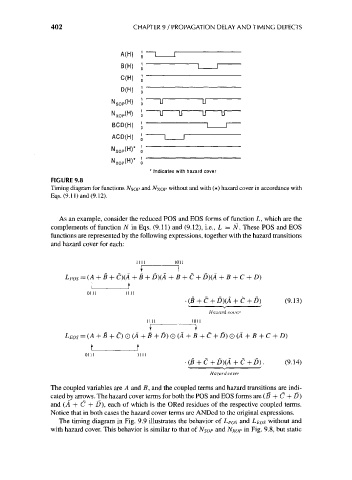
                     FIGURE 9.8
                     Timing diagram for functions N$QP and N\OP without and with (*) hazard cover in accordance with
                     Eqs. (9.11) and (9.12).


                       As an example, consider the reduced POS and EOS forms of function L, which are the
                     complements of function N in Eqs. (9.11) and (9.12), i.e., L = N. These POS and EOS
                     functions are represented by the following expressions, together with the hazard transitions
                     and hazard cover for each:


                                                        1011
                                                  __
                             = (A+B + C}(A + B + D)(A + B + C + D}(A + B + C + D)

                               0111     1111
                                                           '(B + C + D)(A + C + D)      (9.13)
                                                                  Hazard cover
                                                1111        1011

                         LEOS = (A
                                {
                              0111          1111
                                                           .(B + C + DKA + C + D).      (9.14)

                                                                  Hazard cover
                    The coupled variables are A and B, and the coupled terms and hazard transitions are indi-
                    cated by arrows. The hazard cover terms for both the POS and EOS forms are (B + C + D)
                     and (A + C + D), each of which is the ORed residues of the respective coupled terms.
                    Notice that in both cases the hazard cover terms are ANDed to the original expressions.
                       The timing diagram in Fig. 9.9 illustrates the behavior of L POs and L EOs without and
                    with hazard cover. This behavior is similar to that of NSOP and NXOP in Fig. 9.8, but static

