


Page 273 - Facility Piping Systems Handbook for Industrial, Commercial, and Healthcare Facilities
P. 273
HEAT TRANSFER, INSULATION, AND FREEZE PROTECTION

                                    HEAT TRANSFER, INSULATION, AND FREEZE PROTECTION   5.57

                        a steam trap, and a strainer with a blowdown valve should be installed before the steam trap
                        at the end of each tracing run.
                          When condensate is to be disposed of, a subcooling trap will enhance the energy effi-
                        ciency of a tracer system by allowing sensible heat to contribute to the heating duty. These
                        traps release condensate only after it has cooled well below the saturation temperature. Where
                        supply temperature control valves are used, the condensate traps at the end of the tracer run
                        will be in the closed position when the tracing duty is satisfied and the steam is shut off.
                        Since the pressure driving the condensate through the trap will be zero, it is important that the
                        selected trap not require pressure to operate. These traps are classified as free-draining, and
                        are known as temperature-sensing or thermostatic steam traps. The trap should be installed in
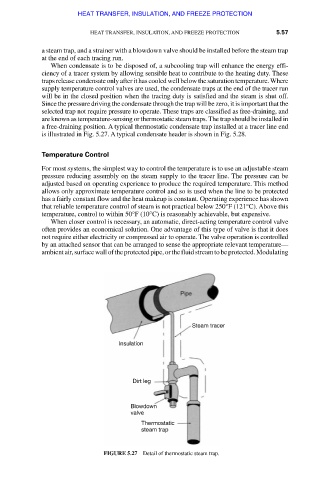
                        a free-draining position. A typical thermostatic condensate trap installed at a tracer line end
                        is illustrated in Fig. 5.27. A typical condensate header is shown in Fig. 5.28.

                        Temperature Control
                        For most systems, the simplest way to control the temperature is to use an adjustable steam
                        pressure reducing assembly on the steam supply to the tracer line. The pressure can be
                        adjusted based on operating experience to produce the required temperature. This method
                        allows only approximate temperature control and so is used when the line to be protected
                        has a fairly constant flow and the heat makeup is constant. Operating experience has shown
                        that reliable temperature control of steam is not practical below 250°F (121°C). Above this
                        temperature, control to within 50°F (10°C) is reasonably achievable, but expensive.
                          When closer control is necessary, an automatic, direct-acting temperature control valve
                        often provides an economical solution. One advantage of this type of valve is that it does
                        not require either electricity or compressed air to operate. The valve operation is controlled
                        by an attached sensor that can be arranged to sense the appropriate relevant temperature—
                        ambient air, surface wall of the protected pipe, or the fluid stream to be protected. Modulating


                                        FIGURE 5.27  Detail of thermostatic steam trap.


                     Downloaded from Digital Engineering Library @ McGraw-Hill (www.accessengineeringlibrary.com)
                                Copyright © 2009 The McGraw-Hill Companies. All rights reserved.
                                  Any use is subject to the Terms of Use as given at the website.

