


Page 320 - Facility Piping Systems Handbook for Industrial, Commercial, and Healthcare Facilities
P. 320
SITE UTILITY SYSTEMS

                      6.42                       CHAPTER SIX

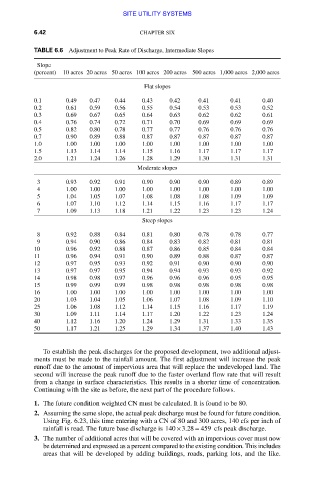
                      TABLE 6.6  Adjustment to Peak Rate of Discharge, Intermediate Slopes

                        Slope
                      (percent)  10 acres  20 acres  50 acres  100 acres  200 acres  500 acres  1,000 acres  2,000 acres
                                                   Flat slopes
                      0.1     0.49  0.47   0.44   0.43   0.42    0.41    0.41     0.40
                      0.2     0.61  0.59   0.56   0.55   0.54    0.53    0.53     0.52
                      0.3     0.69  0.67   0.65   0.64   0.63    0.62    0.62     0.61
                      0.4     0.76  0.74   0.72   0.71   0.70    0.69    0.69     0.69
                      0.5     0.82  0.80   0.78   0.77   0.77    0.76    0.76     0.76
                      0.7     0.90  0.89   0.88   0.87   0.87    0.87    0.87     0.87
                      1.0     1.00  1.00   1.00   1.00   1.00    1.00    1.00     1.00
                      1.5     1.13  1.14   1.14   1.15   1.16    1.17    1.17     1.17
                      2.0     1.21  1.24   1.26   1.28   1.29    1.30    1.31     1.31
                                                 Moderate slopes

                        3     0.93   0.92   0.91   0.90   0.90   0.90    0.89     0.89
                        4     1.00   1.00   1.00   1.00   1.00   1.00    1.00     1.00
                        5     1.04   1.05   1.07   1.08   1.08   1.08    1.09     1.09
                        6     1.07   1.10   1.12   1.14   1.15   1.16    1.17     1.17
                        7     1.09   1.13   1.18   1.21   1.22   1.23    1.23     1.24
                                                  Steep slopes
                        8     0.92   0.88   0.84   0.81   0.80   0.78    0.78     0.77
                        9     0.94   0.90   0.86   0.84   0.83   0.82    0.81     0.81
                      10      0.96  0.92   0.88   0.87   0.86    0.85    0.84     0.84
                      11      0.96  0.94   0.91   0.90   0.89    0.88    0.87     0.87
                      12      0.97  0.95   0.93   0.92   0.91    0.90    0.90     0.90
                      13      0.97  0.97   0.95   0.94   0.94    0.93    0.93     0.92
                      14      0.98  0.98   0.97   0.96   0.96    0.96    0.95     0.95
                      15      0.99  0.99   0.99   0.98   0.98    0.98    0.98     0.98
                      16      1.00  1.00   1.00   1.00   1.00    1.00    1.00     1.00
                      20      1.03  1.04   1.05   1.06   1.07    1.08    1.09     1.10
                      25      1.06  1.08   1.12   1.14   1.15    1.16    1.17     1.19
                      30      1.09  1.11   1.14   1.17   1.20    1.22    1.23     1.24
                      40      1.12  1.16   1.20   1.24   1.29    1.31    1.33     1.35
                      50      1.17  1.21   1.25   1.29   1.34    1.37    1.40     1.43

                        To establish the peak discharges for the proposed development, two additional adjust-
                      ments must be made to the rainfall amount. The first adjustment will increase the peak
                      runoff due to the amount of impervious area that will replace the undeveloped land. The
                      second will increase the peak runoff due to the faster overland flow rate that will result
                      from a change in surface characteristics. This results in a shorter time of concentration.
                      Continuing with the site as before, the next part of the procedure follows.
                      1.  The future condition weighted CN must be calculated. It is found to be 80.
                      2.  Assuming the same slope, the actual peak discharge must be found for future condition.
                        Using Fig. 6.23, this time entering with a CN of 80 and 300 acres, 140 cfs per inch of
                        rainfall is read. The future base discharge is 140 3 28× .  =  459  cfs peak discharge.
                      3.  The number of additional acres that will be covered with an impervious cover must now
                        be determined and expressed as a percent compared to the existing condition. This includes
                        areas that will be developed by adding buildings, roads, parking lots, and the like.


                   Downloaded from Digital Engineering Library @ McGraw-Hill (www.accessengineeringlibrary.com)
                              Copyright © 2009 The McGraw-Hill Companies. All rights reserved.
                                Any use is subject to the Terms of Use as given at the website.

