


Page 325 - Facility Piping Systems Handbook for Industrial, Commercial, and Healthcare Facilities
P. 325
SITE UTILITY SYSTEMS

                                                SITE UTILITY SYSTEMS                 6.47

                            C  = orifice coefficient (use 0.60, an average value)
                            G = 32.2, acceleration due to gravity, 32.2 ft /sec 2

                            H = design head from surface of water to center of outlet pipe
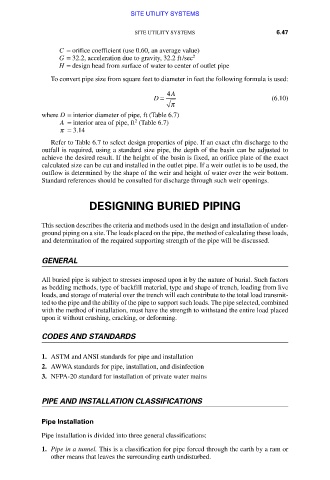
                          To convert pipe size from square feet to diameter in feet the following formula is used:

                                                     D =  4 A                       (6.10)
                                                         π
                        where D = interior diameter of pipe, ft (Table 6.7)
                                                2
                            A = interior area of pipe, ft  (Table 6.7)
                            p  = 3.14
                          Refer to Table 6.7 to select design properties of pipe. If an exact cfm discharge to the
                        outfall is required, using a standard size pipe, the depth of the basin can be adjusted to
                        achieve the desired result. If the height of the basin is fixed, an orifice plate of the exact
                        calculated size can be cut and installed in the outlet pipe. If a weir outlet is to be used, the
                        outflow is determined by the shape of the weir and height of water over the weir bottom.
                        Standard references should be consulted for discharge through such weir openings.


                                    DESIGNING BURIED PIPING


                        This section describes the criteria and methods used in the design and installation of under-
                        ground piping on a site. The loads placed on the pipe, the method of calculating these loads,
                        and determination of the required supporting strength of the pipe will be discussed.


                        GENERAL

                        All buried pipe is subject to stresses imposed upon it by the nature of burial. Such factors
                        as bedding methods, type of backfill material, type and shape of trench, loading from live
                        loads, and storage of material over the trench will each contribute to the total load transmit-
                        ted to the pipe and the ability of the pipe to support such loads. The pipe selected, combined
                        with the method of installation, must have the strength to withstand the entire load placed
                        upon it without crushing, cracking, or deforming.

                        CODES AND STANDARDS

                        1.  ASTM and ANSI standards for pipe and installation
                        2.  AWWA standards for pipe, installation, and disinfection
                        3.  NFPA-20 standard for installation of private water mains


                        PIPE AND INSTALLATION CLASSIFICATIONS

                        Pipe Installation
                        Pipe installation is divided into three general classifications:
                        1.  Pipe in a tunnel. This is a classification for pipe forced through the earth by a ram or
                          other means that leaves the surrounding earth undisturbed.


                     Downloaded from Digital Engineering Library @ McGraw-Hill (www.accessengineeringlibrary.com)
                                Copyright © 2009 The McGraw-Hill Companies. All rights reserved.
                                  Any use is subject to the Terms of Use as given at the website.

