


Page 431 - Fair, Geyer, and Okun's Water and wastewater engineering : water supply and wastewater removal
P. 431
JWCL344_ch11_357-397.qxd  8/2/10  9:01 PM  Page 391


                                                                                    11.17 Estimates of Storm Runoff  391


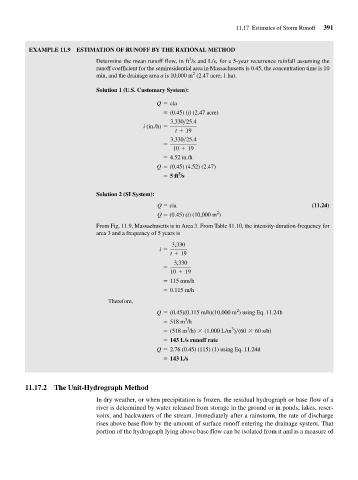
                     EXAMPLE 11.9  ESTIMATION OF RUNOFF BY THE RATIONAL METHOD
                                                                      3
                                         Determine the mean runoff flow, in ft /s and L/s, for a 5-year recurrence rainfall assuming the
                                          runoff coefficient for the semiresidential area in Massachusetts is 0.45, the concentration time is 10
                                                                       2
                                          min, and the drainage area a is 10,000 m (2.47 acre; 1 ha).
                                          Solution 1 (U.S. Customary System):

                                                              Q = cia
                                                               = (0.45) (i) (2.47 acre)
                                                                3,330>25.4
                                                          i (in./h) =
                                                                 t + 19
                                                                3,330>25.4
                                                               =
                                                                 10 + 19
                                                               = 4.52 in./h
                                                              Q = (0.45) (4.52) (2.47)
                                                                  3
                                                               = 5 ft /s

                                          Solution 2 (SI System):
                                                            Q   cia                                        (11.24)
                                                                              2
                                                            Q   (0.45) (i) (10,000 m )
                                         From Fig. 11.9, Massachusetts is in Area 3. From Table 11.10, the intensity-duration-frequency for
                                         area 3 and a frequency of 5 years is

                                                                3,330
                                                               i =
                                                                t + 19
                                                                 3,330
                                                               =
                                                                10 + 19
                                                               = 115 mm/h
                                                               = 0.115 m/h
                                             Therefore,
                                                                                    2
                                                              Q = (0.45)(0.115 m/h)(10,000 m ) using Eq. 11.24b
                                                                    3
                                                               = 518 m /h
                                                                     3
                                                                                   3
                                                               = (518 m /h) * (1,000 L/m )>(60 * 60 s/h)
                                                               = 143 L/s runoff rate
                                                              Q = 2.76 (0.45) (115) (1) using Eq. 11.24d
                                                               = 143 L/s


                    11.17.2  The Unit-Hydrograph Method
                                         In dry weather, or when precipitation is frozen, the residual hydrograph or base flow of a
                                         river is determined by water released from storage in the ground or in ponds, lakes, reser-
                                         voirs, and backwaters of the stream. Immediately after a rainstorm, the rate of discharge
                                         rises above base flow by the amount of surface runoff entering the drainage system. That
                                         portion of the hydrograph lying above base flow can be isolated from it and is a measure of

