


Page 438 - Fair, Geyer, and Okun's Water and wastewater engineering : water supply and wastewater removal
P. 438
JWCL344_ch12_398-456.qxd  8/4/10  9:37 PM  Page 398


                    Chapter 12


                                         Urban Runoff and Combined

                                         Sewer Overflow Management


                    12.1 HYDROLOGIC IMPACTS OF URBANIZATION
                                         Because stormwater flow quantities are high, reaching many orders of magnitude greater
                                         than dry-weather flows, control, whether through flow balancing, multiple uses of facilities,
                                         runoff retardation, or combinations thereof, is the focus of cost-effective planning for
                                         runoff management.
                                             When precipitation contacts the ground surface, it can take several paths. These include
                                         returning to the atmosphere by evaporation; evapotranspiration, which includes direct
                                         evaporation and transpiration from plant surfaces; infiltration into the ground surface; reten-
                                         tion on the ground surface (ponding); and traveling over the ground surface (runoff).
                                         Altering the surface that precipitation contacts alters the fate and transport of the runoff.
                                         Urbanization replaces permeable surfaces with impervious surfaces (e.g., roof tops, roads,
                                         sidewalks, and parking lots), which typically are designed to remove rainfall as quickly as pos-
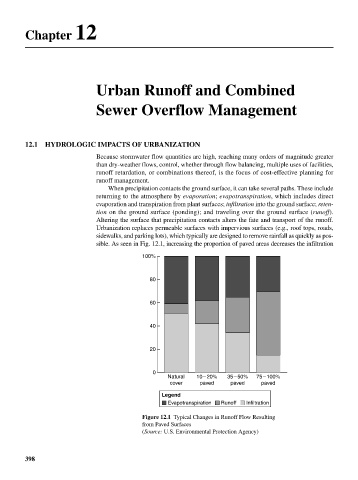
                                         sible. As seen in Fig. 12.1, increasing the proportion of paved areas decreases the infiltration

                                                       100%


                                                          80


                                                          60


                                                          40


                                                          20


                                                           0
                                                               Natural  10 20%   35 50%   75 100%
                                                                cover    paved    paved     paved
                                                             Legend
                                                               Evapotranspiration  Runoff  Infiltration
                                                       Figure 12.1 Typical Changes in Runoff Flow Resulting
                                                       from Paved Surfaces
                                                       (Source: U.S. Environmental Protection Agency)


                    398

