


Page 387 - Fiber Fracture
P. 387
ATOMIC TRANSFORMATIONS                                               369


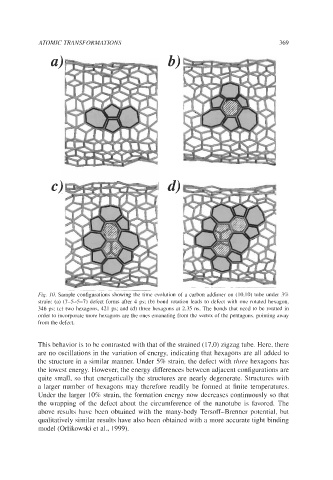
            Fig.  IO.  Sample configurations showing  the time evolution  of a carbon addimer on  (10,lO)  tube under 3%
            strain:  (a) (7-5-5-7)   defect forms after 4 ps; (b) bond rotation  leads to defect with one rotated  hexagon,
            346 ps; (c) two hexagons,  421 ps; and (d) three hexagons at 2.35  ns. The bonds that  need to be rotated  in
            order to incorporate more hexagons  are the ones emanating from the vertex of the pentagons, pointing away
            from the defect.


            This behavior is to be contrasted with that of the strained (17,O)  zigzag tube. Here, there
            are no oscillations in the variation of  energy, indicating that hexagons are all added to
            the structure in a similar manner. Under 5% strain, the defect with three hexagons has
            the lowest energy. However, the energy differences between adjacent configurations are
            quite small, so that energetically the structures  are nearly degenerate.  Structures with
            a larger number  of  hexagons  may  therefore  readily  be  formed  at finite temperatures.
            Under the larger  10% strain, the formation energy now decreases continuously so that
            the  wrapping  of  the  defect  about  the  circumference  of  the  nanotube  is favored. The
            above results  have been  obtained  with the  many-body  Tersoff-Brenner  potential,  but
            qualitatively similar results have also been obtained with a more accurate tight binding
            model (Orlikowski et al., 1999).

