


Page 107 - Fluid Mechanics and Thermodynamics of Turbomachinery
P. 107
88 Fluid Mechanics, Thermodynamics of Turbomachinery


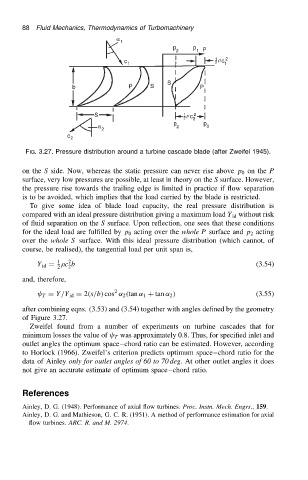
                           FIG. 3.27. Pressure distribution around a turbine cascade blade (after Zweifel 1945).


                          on the S side. Now, whereas the static pressure can never rise above p 0 on the P
                          surface, very low pressures are possible, at least in theory on the S surface. However,
                          the pressure rise towards the trailing edge is limited in practice if flow separation
                          is to be avoided, which implies that the load carried by the blade is restricted.
                            To give some idea of blade load capacity, the real pressure distribution is
                          compared with an ideal pressure distribution giving a maximum load Y id without risk
                          of fluid separation on the S surface. Upon reflection, one sees that these conditions
                          for the ideal load are fulfilled by p 0 acting over the whole P surface and p 2 acting
                          over the whole S surface. With this ideal pressure distribution (which cannot, of
                          course, be realised), the tangential load per unit span is,
                                    1
                                       2
                              Y id D  c b                                                 (3.54)
                                    2  2
                          and, therefore,
                                                   2
                                T D Y/Y id D 2.s/b/ cos ˛ 2 .tan ˛ 1 C tan ˛ 2 /          (3.55)
                          after combining eqns. (3.53) and (3.54) together with angles defined by the geometry
                          of Figure 3.27.
                            Zweifel found from a number of experiments on turbine cascades that for
                          minimum losses the value of   T was approximately 0.8. Thus, for specified inlet and
                          outlet angles the optimum space chord ratio can be estimated. However, according
                          to Horlock (1966). Zweifel’s criterion predicts optimum space chord ratio for the
                          data of Ainley only for outlet angles of 60 to 70 deg. At other outlet angles it does
                          not give an accurate estimate of optimum space chord ratio.


                          References
                          Ainley, D. G. (1948). Performance of axial flow turbines. Proc. Instn. Mech. Engrs., 159.
                          Ainley, D. G. and Mathieson, G. C. R. (1951). A method of performance estimation for axial
                            flow turbines. ARC. R. and M. 2974.

