


Page 105 - Fluid Mechanics and Thermodynamics of Turbomachinery
P. 105
86 Fluid Mechanics, Thermodynamics of Turbomachinery


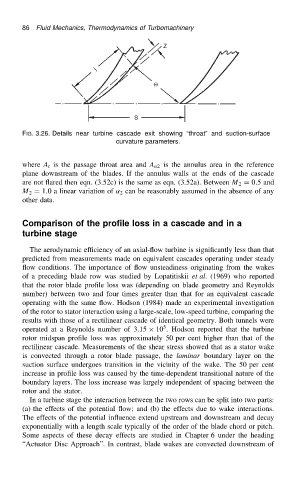
                          FIG. 3.26. Details near turbine cascade exit showing “throat” and suction-surface
                                                    curvature parameters.


                          where A t is the passage throat area and A n2 is the annulus area in the reference
                          plane downstream of the blades. If the annulus walls at the ends of the cascade
                          are not flared then eqn. (3.52c) is the same as eqn. (3.52a). Between M 2 D 0.5 and
                          M 2 D 1.0 a linear variation of ˛ 2 can be reasonably assumed in the absence of any
                          other data.


                          Comparison of the profile loss in a cascade and in a
                          turbine stage

                            The aerodynamic efficiency of an axial-flow turbine is significantly less than that
                          predicted from measurements made on equivalent cascades operating under steady
                          flow conditions. The importance of flow unsteadiness originating from the wakes
                          of a preceding blade row was studied by Lopatitiskii et al. (1969) who reported
                          that the rotor blade profile loss was (depending on blade geometry and Reynolds
                          number) between two and four times greater than that for an equivalent cascade
                          operating with the same flow. Hodson (1984) made an experimental investigation
                          of the rotor to stator interaction using a large-scale, low-speed turbine, comparing the
                          results with those of a rectilinear cascade of identical geometry. Both tunnels were
                                                                 5
                          operated at a Reynolds number of 3.15 ð 10 . Hodson reported that the turbine
                          rotor midspan profile loss was approximately 50 per cent higher than that of the
                          rectilinear cascade. Measurements of the shear stress showed that as a stator wake
                          is convected through a rotor blade passage, the laminar boundary layer on the
                          suction surface undergoes transition in the vicinity of the wake. The 50 per cent
                          increase in profile loss was caused by the time-dependent transitional nature of the
                          boundary layers. The loss increase was largely independent of spacing between the
                          rotor and the stator.
                            In a turbine stage the interaction between the two rows can be split into two parts:
                          (a) the effects of the potential flow; and (b) the effects due to wake interactions.
                          The effects of the potential influence extend upstream and downstream and decay
                          exponentially with a length scale typically of the order of the blade chord or pitch.
                          Some aspects of these decay effects are studied in Chapter 6 under the heading
                          “Actuator Disc Approach”. In contrast, blade wakes are convected downstream of

