


Page 103 - Fluid Mechanics and Thermodynamics of Turbomachinery
P. 103
84 Fluid Mechanics, Thermodynamics of Turbomachinery
                          t/l either 0.25 or 0.15. By substituting ˛ 1 D ˛ 2 and t/l D 0.2 in eqn. (3.46), the
                          zero incidence loss coefficient for the impulse blades Y p.˛1D˛2/ given in Figure 3.25
                          is recovered. Similarly, with ˛ 1 D 0at t/l D 0.2 in eqn. (3.46) gives Y p.˛1D0/ of
                          Figure 3.25.
                            A feature of the losses given in Figure 3.25 is that, compared with the impulse
                          blades, the nozzle blades have a much lower loss coefficient. This trend confirms
                          the results shown in Figure 3.14, that flow in which the mean pressure is falling
                          has a lower loss coefficient than a flow in which the mean pressure is constant
                          or increasing.
                            (ii) The secondary losses arise from complex three-dimensional flows set up as
                          a result of the end wall boundary layers passing through the cascade. There is
                          substantial evidence that the end wall boundary layers are convected inwards along
                          the suction-surface of the blades as the main flow passes through the blade row,
                          resulting in a serious mal-distribution of the flow, with losses in stagnation pressure
                          often a significant fraction of the total loss. Ainley found that secondary losses could
                          be represented by

                                       2
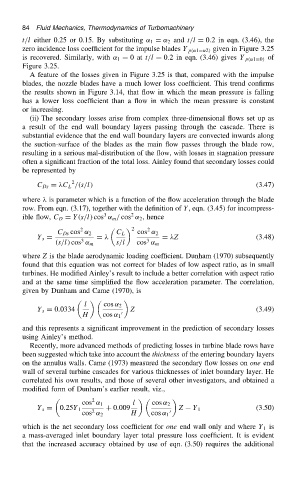
                              C Ds D  C L /.s/l/                                          (3.47)
                          where   is parameter which is a function of the flow acceleration through the blade
                          row. From eqn. (3.17), together with the definition of Y, eqn. (3.45) for incompress-
                                                        2
                                                3
                          ible flow, C D D Y.s/l/ cos ˛ m / cos ˛ 2 , hence
                                          2             2   2
                                    C Ds cos ˛ 2    C L   cos ˛ 2
                              Y s D           D                 D  Z                      (3.48)
                                          3                 3
                                   .s/l/ cos ˛ m    s/l  cos ˛ m
                          where Z is the blade aerodynamic loading coefficient. Dunham (1970) subsequently
                          found that this equation was not correct for blades of low aspect ratio, as in small
                          turbines. He modified Ainley’s result to include a better correlation with aspect ratio
                          and at the same time simplified the flow acceleration parameter. The correlation,
                          given by Dunham and Came (1970), is

                                           l    cos ˛ 2
                              Y s D 0.0334              Z                                 (3.49)
                                          H     cos ˛ 1 0
                          and this represents a significant improvement in the prediction of secondary losses
                          using Ainley’s method.
                            Recently, more advanced methods of predicting losses in turbine blade rows have
                          been suggested which take into account the thickness of the entering boundary layers
                          on the annulus walls. Came (1973) measured the secondary flow losses on one end
                          wall of several turbine cascades for various thicknesses of inlet boundary layer. He
                          correlated his own results, and those of several other investigators, and obtained a
                          modified form of Dunham’s earlier result, viz.,
                                             2

                                          cos ˛ 1       l     cos ˛ 2
                              Y s D  0.25Y 1     C 0.009             Z   Y 1              (3.50)
                                             2                    0
                                          cos ˛ 2       H    cos ˛ 1
                          which is the net secondary loss coefficient for one end wall only and where Y 1 is
                          a mass-averaged inlet boundary layer total pressure loss coefficient. It is evident
                          that the increased accuracy obtained by use of eqn. (3.50) requires the additional

