


Page 100 - Fluid Mechanics and Thermodynamics of Turbomachinery
P. 100
Two-dimensional Cascades  81
                                              0.6

                                              0.5                 h =  0.8
                                                                  0.85
                                             C pi  0.4         0.9 0.9

                                                              0.85
                                              0.3             0.8
                                              0.2
                                                0        1.0      2.0       3.0
                                                              s/
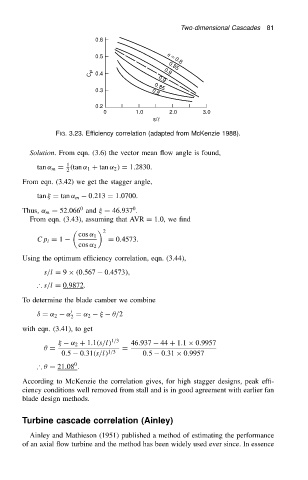
                                   FIG. 3.23. Efficiency correlation (adapted from McKenzie 1988).


                            Solution. From eqn. (3.6) the vector mean flow angle is found,
                                      1
                              tan ˛ m D .tan ˛ 1 C tan ˛ 2 / D 1.2830.
                                      2
                          From eqn. (3.42) we get the stagger angle,
                                            0.213 D 1.0700.
                              tan   D tan ˛ m
                                                        0
                                          0
                          Thus, ˛ m D 52.066 and   D 46.937 .
                            From eqn. (3.43), assuming that AVR D 1.0, we find
                                                 2
                                         cos ˛ 1
                              Cp i D 1           D 0.4573.
                                         cos ˛ 2
                          Using the optimum efficiency correlation, eqn. (3.44),
                                s/l D 9 ð .0.567  0.4573/,
                              ∴ s/l D 0.9872.

                          To determine the blade camber we combine
                                       0
                              υ D ˛ 2  ˛ D ˛ 2      /2
                                       2
                          with eqn. (3.41), to get
                                       ˛ 2 C 1.1.s/l/ 1/3  46.937  44 C 1.1 ð 0.9957
                                  D                  D
                                     0.5  0.31.s/l/ 1/3    0.5  0.31 ð 0.9957
                                        0
                              ∴   D 21.08 .
                          According to McKenzie the correlation gives, for high stagger designs, peak effi-
                          ciency conditions well removed from stall and is in good agreement with earlier fan
                          blade design methods.

                          Turbine cascade correlation (Ainley)

                            Ainley and Mathieson (1951) published a method of estimating the performance
                          of an axial flow turbine and the method has been widely used ever since. In essence

