


Page 97 - Fluid Mechanics and Thermodynamics of Turbomachinery
P. 97
78 Fluid Mechanics, Thermodynamics of Turbomachinery
                          of a suitable cascade geometry when the fluid deflection is given. For this case, if
                          the previous method of a nominal design condition is used, mechanically unsuit-
                          able space chord ratios are a possibility. The space chord ratio may, however, be
                          determined to some extent by the mechanical layout of the compressor, the design
                          incidence then only fortuitously coinciding with the nominal incidence. The design
                          incidence is therefore somewhat arbitrary and some designers, ignoring nominal
                          design conditions, may select an incidence best suited to the operating conditions
                          under which the compressor will run. For instance, a negative design incidence may
                          be chosen so that at reduced flow rates a positive incidence condition is approached.
                          Mach number effects
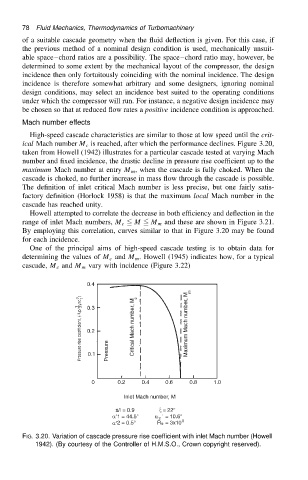
                            High-speed cascade characteristics are similar to those at low speed until the crit-
                          ical Mach number M c is reached, after which the performance declines. Figure 3.20,
                          taken from Howell (1942) illustrates for a particular cascade tested at varying Mach
                          number and fixed incidence, the drastic decline in pressure rise coefficient up to the
                          maximum Mach number at entry M m , when the cascade is fully choked. When the
                          cascade is choked, no further increase in mass flow through the cascade is possible.
                          The definition of inlet critical Mach number is less precise, but one fairly satis-
                          factory definition (Horlock 1958) is that the maximum local Mach number in the
                          cascade has reached unity.
                            Howell attempted to correlate the decrease in both efficiency and deflection in the
                          range of inlet Mach numbers, M c 5 M 5 M m and these are shown in Figure 3.21.
                          By employing this correlation, curves similar to that in Figure 3.20 may be found
                          for each incidence.
                            One of the principal aims of high-speed cascade testing is to obtain data for
                          determining the values of M c and M m . Howell (1945) indicates how, for a typical
                          cascade, M c and M m vary with incidence (Figure 3.22)


                          FIG. 3.20. Variation of cascade pressure rise coefficient with inlet Mach number (Howell
                             1942). (By courtesy of the Controller of H.M.S.O., Crown copyright reserved).

