


Page 93 - Fluid Mechanics and Thermodynamics of Turbomachinery
P. 93
74 Fluid Mechanics, Thermodynamics of Turbomachinery
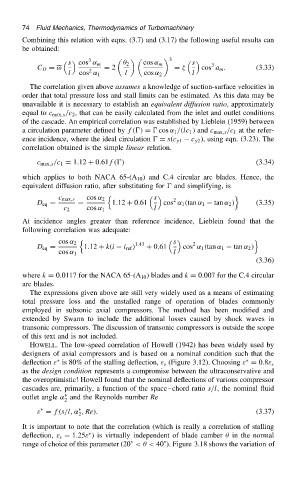
Combining this relation with eqns. (3.7) and (3.17) the following useful results can
be obtained:
3
s
cos ˛ m 2 cos ˛ m 3
s
3
C D D ω D 2 D cos a m . (3.33)
2
l cos ˛ 1 l cos ˛ 2 l
The correlation given above assumes a knowledge of suction-surface velocities in
order that total pressure loss and stall limits can be estimated. As this data may be
unavailable it is necessary to establish an equivalent diffusion ratio, approximately
equal to c max,s /c 2 , that can be easily calculated from the inlet and outlet conditions
of the cascade. An empirical correlation was established by Lieblein (1959) between
a circulation parameter defined by f./ D cos ˛ 1 /.lc 1 / and c max,s /c 1 at the refer-
c y2 /, using eqn. (3.23). The
ence incidence, where the ideal circulation D s.c y1
correlation obtained is the simple linear relation.
c max,s /c 1 D 1.12 C 0.61f./ (3.34)
which applies to both NACA 65-(A 10 ) and C.4 circular arc blades. Hence, the
equivalent diffusion ratio, after substituting for and simplifying, is
n o
c max,s cos ˛ 2 s 2
D eq D D 1.12 C 0.61 cos ˛ 1 .tan ˛ 1 tan ˛ 2 / (3.35)
c 2 cos ˛ 1 l
At incidence angles greater than reference incidence, Lieblein found that the
following correlation was adequate:
n o
cos ˛ 2 1.43 s 2
D eq D 1.12 C k.i i ref / C 0.61 cos ˛ 1 .tan ˛ 1 tan ˛ 2 /
cos ˛ 1 l
(3.36)
where k D 0.0117 for the NACA 65-(A 10 ) blades and k D 0.007 for the C.4 circular
arc blades.
The expressions given above are still very widely used as a means of estimating
total pressure loss and the unstalled range of operation of blades commonly
employed in subsonic axial compressors. The method has been modified and
extended by Swann to include the additional losses caused by shock waves in
transonic compressors. The discussion of transonic compressors is outside the scope
of this text and is not included.
HOWELL. The low-speed correlation of Howell (1942) has been widely used by
designers of axial compressors and is based on a nominal condition such that the
Ł Ł
deflection ε is 80% of the stalling deflection, ε s (Figure 3.12). Choosing ε D 0.8ε s
as the design condition represents a compromise between the ultraconservative and
the overoptimistic! Howell found that the nominal deflections of various compressor
cascades are, primarily, a function of the space chord ratio s/l, the nominal fluid
Ł
outlet angle ˛ and the Reynolds number Re
2
Ł
Ł
ε D f.s/l, ˛ , Re/. (3.37)
2
It is important to note that the correlation (which is really a correlation of stalling
Ł
deflection, ε s D 1.25ε ) is virtually independent of blade camber in the normal
range of choice of this parameter (20 ° < < 40 ° ). Figure 3.18 shows the variation of

