


Page 90 - Fluid Mechanics and Thermodynamics of Turbomachinery
P. 90
Two-dimensional Cascades  71


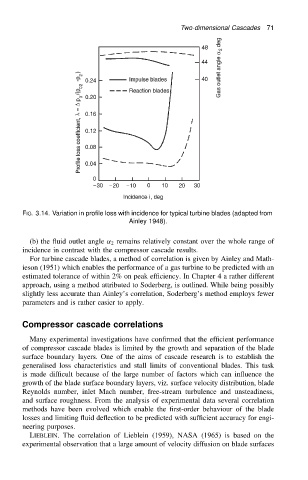
                          FIG. 3.14. Variation in profile loss with incidence for typical turbine blades (adapted from
                                                       Ainley 1948).


                            (b) the fluid outlet angle ˛ 2 remains relatively constant over the whole range of
                          incidence in contrast with the compressor cascade results.
                            For turbine cascade blades, a method of correlation is given by Ainley and Math-
                          ieson (1951) which enables the performance of a gas turbine to be predicted with an
                          estimated tolerance of within 2% on peak efficiency. In Chapter 4 a rather different
                          approach, using a method attributed to Soderberg, is outlined. While being possibly
                          slightly less accurate than Ainley’s correlation, Soderberg’s method employs fewer
                          parameters and is rather easier to apply.


                          Compressor cascade correlations

                            Many experimental investigations have confirmed that the efficient performance
                          of compressor cascade blades is limited by the growth and separation of the blade
                          surface boundary layers. One of the aims of cascade research is to establish the
                          generalised loss characteristics and stall limits of conventional blades. This task
                          is made difficult because of the large number of factors which can influence the
                          growth of the blade surface boundary layers, viz. surface velocity distribution, blade
                          Reynolds number, inlet Mach number, free-stream turbulence and unsteadiness,
                          and surface roughness. From the analysis of experimental data several correlation
                          methods have been evolved which enable the first-order behaviour of the blade
                          losses and limiting fluid deflection to be predicted with sufficient accuracy for engi-
                          neering purposes.
                            LIEBLEIN. The correlation of Lieblein (1959), NASA (1965) is based on the
                          experimental observation that a large amount of velocity diffusion on blade surfaces

