


Page 89 - Fluid Mechanics and Thermodynamics of Turbomachinery
P. 89
70 Fluid Mechanics, Thermodynamics of Turbomachinery
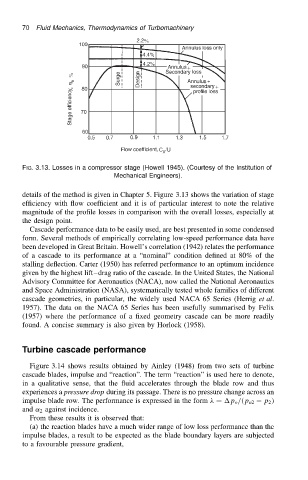
FIG. 3.13. Losses in a compressor stage (Howell 1945). (Courtesy of the Institution of
Mechanical Engineers).
details of the method is given in Chapter 5. Figure 3.13 shows the variation of stage
efficiency with flow coefficient and it is of particular interest to note the relative
magnitude of the profile losses in comparison with the overall losses, especially at
the design point.
Cascade performance data to be easily used, are best presented in some condensed
form. Several methods of empirically correlating low-speed performance data have
been developed in Great Britain. Howell’s correlation (1942) relates the performance
of a cascade to its performance at a “nominal” condition defined at 80% of the
stalling deflection. Carter (1950) has referred performance to an optimum incidence
given by the highest lift drag ratio of the cascade. In the United States, the National
Advisory Committee for Aeronautics (NACA), now called the National Aeronautics
and Space Administration (NASA), systematically tested whole families of different
cascade geometries, in particular, the widely used NACA 65 Series (Herrig et al.
1957). The data on the NACA 65 Series has been usefully summarised by Felix
(1957) where the performance of a fixed geometry cascade can be more readily
found. A concise summary is also given by Horlock (1958).
Turbine cascade performance
Figure 3.14 shows results obtained by Ainley (1948) from two sets of turbine
cascade blades, impulse and “reaction”. The term “reaction” is used here to denote,
in a qualitative sense, that the fluid accelerates through the blade row and thus
experiences a pressure drop during its passage. There is no pressure change across an
p 2 /
impulse blade row. The performance is expressed in the form D p o /.p o2
and ˛ 2 against incidence.
From these results it is observed that:
(a) the reaction blades have a much wider range of low loss performance than the
impulse blades, a result to be expected as the blade boundary layers are subjected
to a favourable pressure gradient,

