Page 115 - Fluid Mechanics and Thermodynamics of Turbomachinery
P. 115
96 Fluid Mechanics, Thermodynamics of Turbomachinery
                          Stage losses and efficiency

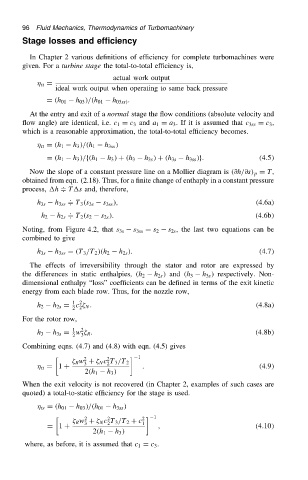
                            In Chapter 2 various definitions of efficiency for complete turbomachines were
                          given. For a turbine stage the total-to-total efficiency is,
                                                   actual work output
                                tt D
                                   ideal work output when operating to same back pressure
                                 D .h 01  h 03 //.h 01  h 03ss/ .
                            At the entry and exit of a normal stage the flow conditions (absolute velocity and
                          flow angle) are identical, i.e. c 1 D c 3 and a 1 D a 3 . If it is assumed that c 3ss D c 3 ,
                          which is a reasonable approximation, the total-to-total efficiency becomes.
                                                 h 3ss /
                                tt D .h 1  h 3 //.h 1
                                 D .h 1  h 3 //f.h 1  h 3 / C .h 3  h 3s / C .h 3s  h 3ss /g.  .4.5/
                            Now the slope of a constant pressure line on a Mollier diagram is .∂h/∂s/ p D T,
                          obtained from eqn. (2.18). Thus, for a finite change of enthaply in a constant pressure
                          process, h + Ts and, therefore,
                                                s 3ss /,                                  .4.6a/
                              h 3s  h 3ss + T 3 .s 3s
                                                s 2s /.                                   .4.6b/
                               h 2  h 2s + T 2 .s 2
                                                                  s 2s , the last two equations can be
                          Noting, from Figure 4.2, that s 3s  s 3ss D s 2
                          combined to give
                                                    h 2s /.                                .4.7/
                              h 3s  h 3ss D .T 3 /T 2 /.h 2
                            The effects of irreversibility through the stator and rotor are expressed by
                          the differences in static enthalpies, .h 2  h 2s / and .h 3  h 3s / respectively. Non-
                          dimensional enthalpy “loss” coefficients can be defined in terms of the exit kinetic
                          energy from each blade row. Thus, for the nozzle row,
                                        1 2
                                  h 2s D c   N .                                          .4.8a/
                              h 2
                                        2 2
                          For the rotor row,
                                        1  2
                              h 3  h 3s D w   R .                                         .4.8b/
                                          3
                                        2
                          Combining eqns. (4.7) and (4.8) with eqn. (4.5) gives
                                                          1
                                           2     2
                                          R w C   N c T 3 /T 2
                                           3
                                                 2
                                tt D 1 C                   .                               .4.9/
                                           2.h 1  h 3 /
                          When the exit velocity is not recovered (in Chapter 2, examples of such cases are
                          quoted) a total-to-static efficiency for the stage is used.
                                                   h 3ss /
                                ts D .h 01  h 03 //.h 01
                                           2     2         2    1
                                          R w C   N c T 3 /T 2 C c 1
                                                 2
                                           3
                                 D 1 C                         ,                          .4.10/
                                             2.h 1  h 3 /
                           where, as before, it is assumed that c 1 D c 3 .
   110   111   112   113   114   115   116   117   118   119   120