


Page 116 - Fluid Mechanics and Thermodynamics of Turbomachinery
P. 116
Axial-flow Turbines: Two-dimensional Theory  97
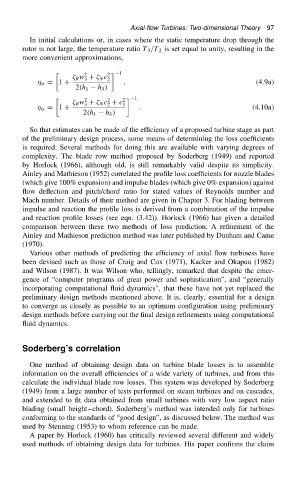
                            In initial calculations or, in cases where the static temperature drop through the
                          rotor is not large, the temperature ratio T 3 /T 2 is set equal to unity, resulting in the
                          more convenient approximations,

                                           2     2    1
                                          R w C   N c 2
                                           3
                                tt D 1 C              ,                                   .4.9a/
                                         2.h 1  h 3 /
                                           2     2    2    1
                                          R w C   N c C c 1
                                           3
                                                 2
                                ts D 1 C                  .                              .4.10a/
                                           2.h 1  h 3 /
                            So that estimates can be made of the efficiency of a proposed turbine stage as part
                          of the preliminary design process, some means of determining the loss coefficients
                          is required. Several methods for doing this are available with varying degrees of
                          complexity. The blade row method proposed by Soderberg (1949) and reported
                          by Horlock (1966), although old, is still remarkably valid despite its simplicity.
                          Ainley and Mathieson (1952) correlated the profile loss coefficients for nozzle blades
                          (which give 100% expansion) and impulse blades (which give 0% expansion) against
                          flow deflection and pitch/chord ratio for stated values of Reynolds number and
                          Mach number. Details of their method are given in Chapter 3. For blading between
                          impulse and reaction the profile loss is derived from a combination of the impulse
                          and reaction profile losses (see eqn. (3.42)). Horlock (1966) has given a detailed
                          comparison between these two methods of loss prediction. A refinement of the
                          Ainley and Mathieson prediction method was later published by Dunham and Came
                          (1970).
                            Various other methods of predicting the efficiency of axial flow turbiness have
                          been devised such as those of Craig and Cox (1971), Kacker and Okapuu (1982)
                          and Wilson (1987). It was Wilson who, tellingly, remarked that despite the emer-
                          gence of “computer programs of great power and sophistication”, and “generally
                          incorporating computational fluid dynamics”, that these have not yet replaced the
                          preliminary design methods mentioned above. It is, clearly, essential for a design
                          to converge as closely as possible to an optimum configuration using preliminary
                          design methods before carrying out the final design refinements using computational
                          fluid dynamics.


                          Soderberg’s correlation

                            One method of obtaining design data on turbine blade losses is to assemble
                          information on the overall efficiencies of a wide variety of turbines, and from this
                          calculate the individual blade row losses. This system was developed by Soderberg
                          (1949) from a large number of tests performed on steam turbines and on cascades,
                          and extended to fit data obtained from small turbines with very low aspect ratio
                          blading (small height chord). Soderberg’s method was intended only for turbines
                          conforming to the standards of “good design”, as discussed below. The method was
                          used by Stenning (1953) to whom reference can be made.
                            A paper by Horlock (1960) has critically reviewed several different and widely
                          used methods of obtaining design data for turbines. His paper confirms the claim

