


Page 120 - Fluid Mechanics and Thermodynamics of Turbomachinery
P. 120
Axial-flow Turbines: Two-dimensional Theory 101
2
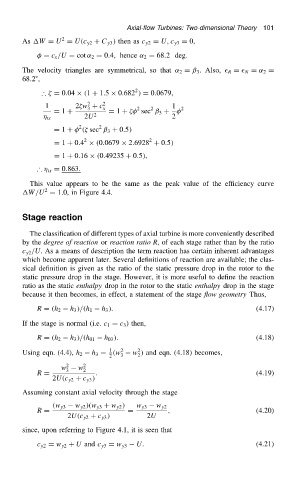
As W D U D U.c y2 C C y3 / then as c y2 D U, c y3 D 0,
D c x /U D cot ˛ 2 D 0.4, hence ˛ 2 D 68.2 deg.
The velocity triangles are symmetrical, so that ˛ 2 D ˇ 3 . Also, R D N D ˛ 2 D
68.2 ° ,
2
∴ D 0.04 ð .1 C 1.5 ð 0.682 / D 0.0679,
2
1 2 w C c 2 x 2 2 1 2
3
D 1 C 2 D 1 C sec ˇ 3 C
ts 2U 2
2
2
D 1 C . sec ˇ 3 C 0.5/
2
2
D 1 C 0.4 ð .0.0679 ð 2.6928 C 0.5/
D 1 C 0.16 ð .0.49235 C 0.5/,
∴ ts D 0.863.
This value appears to be the same as the peak value of the efficiency curve
2
W/U D 1.0, in Figure 4.4.
Stage reaction
The classification of different types of axial turbine is more conveniently described
by the degree of reaction or reaction ratio R, of each stage rather than by the ratio
c y2 /U. As a means of description the term reaction has certain inherent advantages
which become apparent later. Several definitions of reaction are available; the clas-
sical definition is given as the ratio of the static pressure drop in the rotor to the
static pressure drop in the stage. However, it is more useful to define the reaction
ratio as the static enthalpy drop in the rotor to the static enthalpy drop in the stage
because it then becomes, in effect, a statement of the stage flow geometry Thus,
h 3 /. (4.17)
R D .h 2 h 3 //.h 1
If the stage is normal (i.e. c 1 D c 3 ) then,
R D .h 2 h 3 //.h 01 h 03 /. (4.18)
1
2
h 3 D .w 2 w / and eqn. (4.18) becomes,
Using eqn. (4.4), h 2 3 2
2
w 3 2 w 2 2
R D . (4.19)
2U.c y2 C c y3 /
Assuming constant axial velocity through the stage
.w y3 w y2 /.w y3 C w y2 / w y3 w y2
R D D , (4.20)
2U.c y2 C c y3 / 2U
since, upon referring to Figure 4.1, it is seen that
U. (4.21)
c y2 D w y2 C U and c y3 D w y3

