


Page 135 - Fluid Power Engineering
P. 135
Hydraulic Pumps      109


               via a groove in the cam surface to the bore of the piston into the
               pumping chamber.
                   Phase 3: The piston is at the lower dead point. The pumping
               chamber is completely filled (maximum volume). The suction valve
               and exit check valve are closed.
                   Phase 4: As the cam rotates, the piston is moved outwards in the
                 radial direction. The fluid is com pressed in the displacement chamber.
               The increased fluid pressure opens the exit check valve, and the fluid
               flows into the ring chan nel (13), which connects the pumping elements.


               4.6.7  Radial Piston Pumps of Crank Type
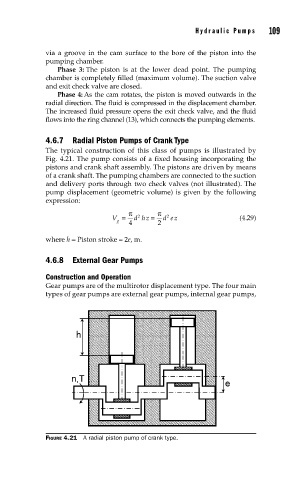
               The typical construction of this class of pumps is illustrated by
               Fig. 4.21. The pump consists of a fixed housing incorporating the
               pistons and crank shaft assembly. The pistons are driven by means
               of a crank shaft. The pumping chambers are connected to the suction
               and delivery ports through two check valves (not illustrated). The
               pump displacement (geometric volume) is given by the following
               expression:
                                      π       π
                                         2
                                                 2
                                  V =   d hz =  d ez                (4.29)
                                   g  4       2
               where h = Piston stroke = 2e, m.

               4.6.8  External Gear Pumps

               Construction and Operation
               Gear pumps are of the multirotor displacement type. The four main
               types of gear pumps are external gear pumps, internal gear pumps,


               FIGURE 4.21  A radial piston pump of crank type.

