


Page 140 - Fluid Power Engineering
P. 140
114    Cha pte r  F o u r


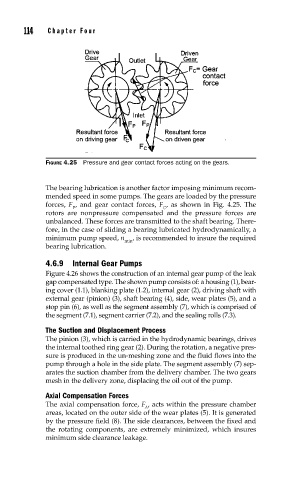
               FIGURE 4.25  Pressure and gear contact forces acting on the gears.


               The bearing lubrication is another factor imposing minimum recom-
               mended speed in some pumps. The gears are loaded by the pressure
               forces,  F , and gear contact forces,  F , as shown in Fig. 4.25. The
                       P                        C
                 rotors are nonpressure compensated and the pressure forces are
                unbalanced. These forces are transmitted to the shaft bearing. There-
               fore, in the case of sliding a bearing lubricated hydrodynamically, a
               minimum pump speed, n   , is recommended to insure the required
                                     min
               bearing lubrication.

               4.6.9  Internal Gear Pumps
               Figure 4.26 shows the construction of an internal gear pump of the leak
               gap compensated type. The shown pump consists of: a housing (1), bear-
               ing cover (1.1), blanking plate (1.2), internal gear (2), driving shaft with
               external gear (pinion) (3), shaft bearing (4), side, wear plates (5), and a
               stop pin (6), as well as the segment assembly (7), which is comprised of
               the segment (7.1), segment carrier (7.2), and the sealing rolls (7.3).
               The Suction and Displacement Process
               The pinion (3), which is carried in the hydrodynamic bearings, drives
               the internal toothed ring gear (2). During the rotation, a negative pres-
               sure is produced in the un-meshing zone and the fluid flows into the
               pump through a hole in the side plate. The segment assembly (7) sep-
               arates the suction chamber from the delivery chamber. The two gears
               mesh in the delivery zone, displacing the oil out of the pump.

               Axial Compensation Forces
               The axial compensation force, F , acts within the pressure chamber
                                          A
               areas, located on the outer side of the wear plates (5). It is generated
               by the pressure field (8). The side clearances, between the fixed and
               the rotating components, are extremely minimized, which insures
               minimum side clearance leakage.

