


Page 144 - Fluid Power Engineering
P. 144
118    Cha pte r  F o u r


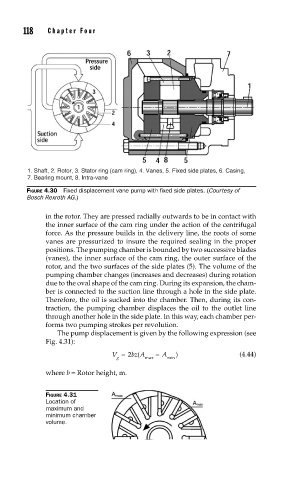
          1. Shaft, 2. Rotor, 3. Stator ring (cam ring), 4. Vanes, 5. Fixed side plates, 6. Casing,
          7. Bearing mount, 8. Intra-vane
          FIGURE 4.30  Fixed displacement vane pump with fi xed side plates. (Courtesy of
          Bosch Rexroth AG.)

               in the rotor. They are pressed radially outwards to be in contact with
               the inner surface of the cam ring under the action of the centrifugal
               force. As the pressure builds in the delivery line, the roots of some
               vanes are pressurized to insure the required sealing in the proper
               positions. The pumping chamber is bounded by two successive blades
               (vanes), the inner surface of the cam ring, the outer surface of the
               rotor, and the two surfaces of the side plates (5). The volume of the
               pumping chamber changes (increases and decreases) during rotation
               due to the oval shape of the cam ring. During its expansion, the cham-
               ber is connected to the suction line through a hole in the side plate.
               Therefore, the oil is sucked into the chamber. Then, during its con-
               traction, the pumping chamber displaces the oil to the outlet line
               through another hole in the side plate. In this way, each chamber per-
               forms two pumping strokes per revolution.
                   The pump displacement is given by the following expression (see
               Fig. 4.31):
                                  V = 2 bz A  −  A  )               (4.44)
                                         (
                                   g       max   min
               where b = Rotor height, m.

               FIGURE 4.31
               Location of
               maximum and
               minimum chamber
               volume.

