


Page 149 - Fluid Power Engineering
P. 149
Hydraulic Pumps      123


                    •  Hydraulic servo controllers, for closed-loop control of the pump
                      displacement
                    •  Electrohydraulic proportional controllers, for open-loop control
                      of the pump displacement
                    •  Electrohydraulic servo controllers, for open- and closed-loop
                      control of the pump displacement

               4.7.2 Pressure-Compensated Vane Pumps

               Construction and Operation
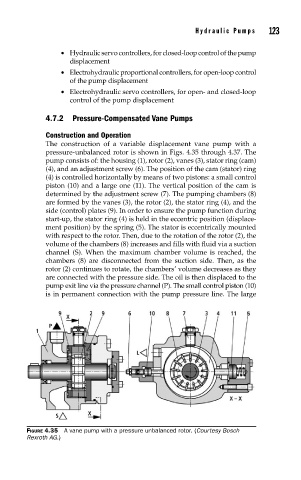
               The construction of a variable displacement vane pump with a
               pressure-unbalanced rotor is shown in Figs. 4.35 through 4.37. The
               pump consists of: the housing (1), rotor (2), vanes (3), stator ring (cam)
               (4), and an adjustment screw (6). The position of the cam (stator) ring
               (4) is controlled horizontally by means of two pistons: a small control
               piston (10) and a large one (11). The vertical position of the cam is
               determined by the adjustment screw (7). The pumping chambers (8)
               are formed by the vanes (3), the rotor (2), the stator ring (4), and the
               side (control) plates (9). In order to ensure the pump function during
               start-up, the stator ring (4) is held in the eccentric position (displace-
               ment position) by the spring (5). The stator is eccentrically mounted
               with respect to the rotor. Then, due to the rotation of the rotor (2), the
               volume of the chambers (8) increases and fills with fluid via a suction
               channel (S). When the maximum chamber volume is reached, the
               chambers (8) are disconnected from the suction side. Then, as the
                rotor (2) continues to rotate, the chambers’ volume decreases as they
               are connected with the pressure side. The oil is then displaced to the
               pump exit line via the pressure channel (P). The small control piston (10)
               is in permanent connection with the pump pressure line. The large


          FIGURE 4.35  A vane pump with a pressure unbalanced rotor. (Courtesy Bosch
          Rexroth AG.)

