


Page 151 - Fluid Power Engineering
P. 151
Hydraulic Pumps      125


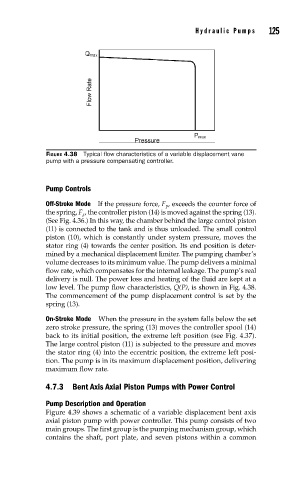
               FIGURE 4.38  Typical fl ow characteristics of a variable displacement vane
                pump with a pressure compensating controller.


               Pump Controls

               Off-Stroke Mode  If the pressure force, F , exceeds the counter force of
                                                P
               the spring, F , the controller piston (14) is moved against the spring (13).
                         F
               (See Fig. 4.36.) In this way, the chamber behind the large control piston
               (11) is connected to the tank and is thus unloaded. The small control
               piston (10), which is constantly under system pressure, moves the
               stator ring (4) towards the center position. Its end position is deter-
               mined by a mechanical displacement limiter. The pumping chamber’s
               volume decreases to its minimum value. The pump delivers a minimal
               flow rate, which compensates for the internal leakage. The pump’s real
               delivery is null. The power loss and heating of the fluid are kept at a
               low level. The pump flow characteristics, Q(P), is shown in Fig. 4.38.
               The commencement of the pump displacement control is set by the
               spring (13).
               On-Stroke Mode  When the pressure in the system falls below the set
               zero stroke pressure, the spring (13) moves the controller spool (14)
               back to its initial position, the extreme left position (see Fig. 4.37).
               The large control piston (11) is subjected to the pressure and moves
               the stator ring (4) into the eccentric position, the extreme left posi-
               tion. The pump is in its maximum displacement position, delivering
               maximum flow rate.

               4.7.3  Bent Axis Axial Piston Pumps with Power Control

               Pump Description and Operation
               Figure 4.39 shows a schematic of a variable displacement bent axis
               axial piston pump with power controller. This pump consists of two
               main groups. The first group is the pumping mechanism group, which
               contains the shaft, port plate, and seven pistons within a common

