


Page 155 - Fluid Power Engineering
P. 155
Hydraulic Pumps      129


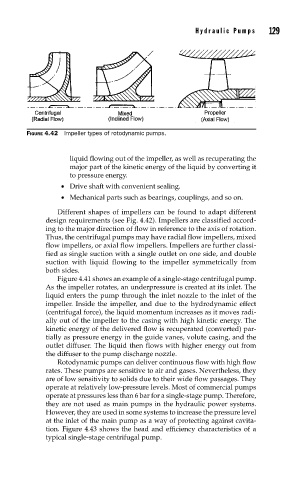
          FIGURE 4.42  Impeller types of rotodynamic pumps.


                      liquid flowing out of the impeller, as well as recuperating the
                      major part of the kinetic energy of the liquid by converting it
                      to pressure energy.
                    •  Drive shaft with convenient sealing.
                    •  Mechanical parts such as bearings, couplings, and so on.
                   Different shapes of impellers can be found to adapt different
               design requirements (see Fig. 4.42). Impellers are classified accord-
               ing to the major direction of flow in reference to the axis of rotation.
               Thus, the centrifugal pumps may have radial flow impellers, mixed
               flow impellers, or axial flow impellers. Impellers are further classi-
               fied as single suction with a single outlet on one side, and double
               suction with liquid flowing to the impeller symmetrically from
               both sides.
                   Figure 4.41 shows an example of a single-stage centrifugal pump.
               As the impeller rotates, an underpressure is created at its inlet. The
               liquid enters the pump through the inlet nozzle to the inlet of the
               impeller. Inside the impeller, and due to the hydrodynamic effect
               (centrifugal force), the liquid momentum increases as it moves radi-
               ally out of the impeller to the casing with high kinetic energy. The
               kinetic energy of the delivered flow is recuperated (converted) par-
               tially as pressure energy in the guide vanes, volute casing, and the
               outlet diffuser. The liquid then flows with higher energy out from
               the diffuser to the pump discharge nozzle.
                   Rotodynamic pumps can deliver continuous flow with high flow
               rates. These pumps are sensitive to air and gases. Nevertheless, they
               are of low sensitivity to solids due to their wide flow passages. They
               operate at relatively low-pressure levels. Most of commercial pumps
               operate at pressures less than 6 bar for a single-stage pump. Therefore,
               they are not used as main pumps in the hydraulic power systems.
               However, they are used in some systems to increase the pressure  level
               at the inlet of the main pump as a way of protecting against cavita-
               tion. Figure 4.43 shows the head and efficiency characteristics of a
               typical single-stage  centrifugal pump.

