


Page 153 - Fluid Power Engineering
P. 153
Hydraulic Pumps      127


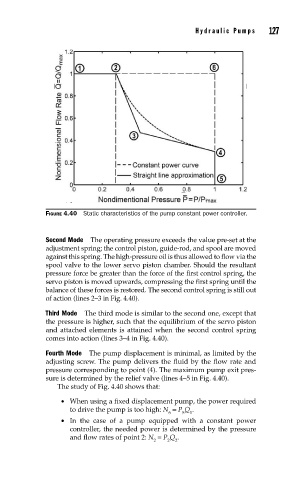
               FIGURE 4.40  Static characteristics of the pump constant power controller.


               Second Mode  The operating pressure exceeds the value pre-set at the
               adjustment spring; the control piston, guide-rod, and spool are moved
               against this spring. The high-pressure oil is thus allowed to flow via the
               spool valve to the lower servo piston chamber. Should the resultant
               pressure force be greater than the force of the first control spring, the
               servo piston is moved upwards, compressing the first spring until the
               balance of these forces is restored. The second control spring is still out
               of action (lines 2–3 in Fig. 4.40).
               Third Mode  The third mode is similar to the second one, except that
               the pressure is higher, such that the equilibrium of the servo piston
               and attached elements is attained when the second control spring
               comes into action (lines 3–4 in Fig. 4.40).
               Fourth Mode  The pump displacement is minimal, as limited by the
               adjusting screw. The pump delivers the fluid by the flow rate and
               pressure corresponding to point (4). The maximum pump exit pres-
               sure is determined by the relief valve (lines 4–5 in Fig. 4.40).
                   The study of Fig. 4.40 shows that:
                    •  When using a fixed displacement pump, the power required
                      to drive the pump is too high: N  = P Q .
                                                 6   5  1
                    •  In the case of a pump equipped with a constant power
                      controller, the needed power is determined by the pressure
                      and flow rates of point 2: N  = P Q .
                                             2   2  2

