


Page 186 - Foundations of Cognitive Psychology : Core Readings
P. 186
190   Stephen E. Palmer


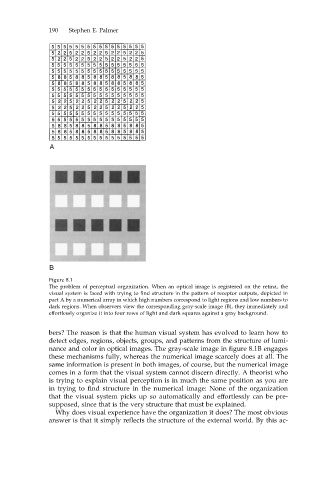
                Figure 8.1
                The problem of perceptual organization. When an optical image is registered on the retina, the
                visual system is faced with trying to find structure in the pattern of receptor outputs, depicted in
                part A by a numerical array in which high numbers correspond to light regions and low numbers to
                dark regions. When observers view the corresponding gray-scale image (B), they immediately and
                effortlessly organize it into four rows of light and dark squares against a gray background.


                bers? The reason is that the human visual system has evolved to learn how to
                detect edges, regions, objects, groups, and patterns from the structure of lumi-
                nance and color in optical images. The gray-scale image in figure 8.1B engages
                these mechanisms fully, whereas the numerical image scarcely does at all. The
                same information is present in both images, of course, but the numerical image
                comes in a form that the visual system cannot discern directly. A theorist who
                is trying to explain visual perception is in much the same position as you are
                in trying to find structure in the numerical image: None of the organization
                that the visual system picks up so automatically and effortlessly can be pre-
                supposed, since that is the very structure that must be explained.
                  Why does visual experience have the organization it does? The most obvious
                answer is that it simply reflects the structure of the external world. By this ac-

