


Page 191 - Foundations of Cognitive Psychology : Core Readings
P. 191
Organizing Objects and Scenes  195


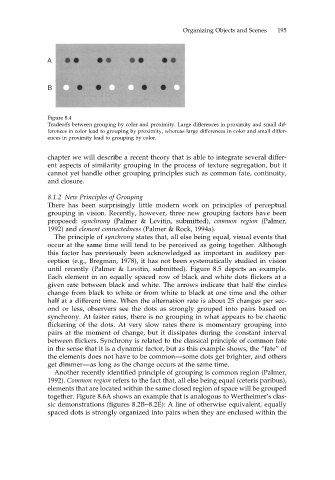
               Figure 8.4
               Tradeoffs between grouping by color and proximity. Large differences in proximity and small dif-
               ferences in color lead to grouping by proximity, whereas large differences in color and small differ-
               ences in proximity lead to grouping by color.


               chapter we will describe a recent theory that is able to integrate several differ-
               ent aspects of similarity grouping in the process of texture segregation, but it
               cannot yet handle other grouping principles such as common fate, continuity,
               and closure.
               8.1.2 New Principles of Grouping
               There has been surprisingly little modern work on principles of perceptual
               grouping in vision. Recently, however, three new grouping factors have been
               proposed: synchrony (Palmer & Levitin, submitted), common region (Palmer,
               1992) and element connectedness (Palmer & Rock, 1994a).
                 The principle of synchrony states that, all else being equal, visual events that
               occur at the same time will tend to be perceived as going together. Although
               this factor has previously been acknowledged as important in auditory per-
               ception (e.g., Bregman, 1978), it has not been systematically studied in vision
               until recently (Palmer & Levitin, submitted). Figure 8.5 depicts an example.
               Each element in an equally spaced row of black and white dots flickers at a
               given rate between black and white. The arrows indicate that half the circles
               change from black to white or from white to black at one time and the other
               half at a different time. When the alternation rate is about 25 changes per sec-
               ond or less, observers see the dots as strongly grouped into pairs based on
               synchrony. At faster rates, there is no grouping in what appears to be chaotic
               flickering of the dots. At very slow rates there is momentary grouping into
               pairs at the moment of change, but it dissipates during the constant interval
               between flickers. Synchrony is related to the classical principle of common fate
               in the sense that it is a dynamic factor, but as this example shows, the ‘‘fate’’ of
               theelementsdoesnot havetobecommon—some dots getbrighter, and others
               get dimmer—as long as the change occurs at the same time.
                 Another recently identified principle of grouping is common region (Palmer,
               1992). Common region refers to the fact that, all else being equal (ceteris paribus),
               elements that are located within the same closed region of space will be grouped
               together. Figure 8.6A shows an example that is analogous to Wertheimer’s clas-
               sic demonstrations (figures 8.2B–8.2E): A line of otherwise equivalent, equally
               spaced dots is strongly organized into pairs when they are enclosed within the

