


Page 194 - Foundations of Cognitive Psychology : Core Readings
P. 194
198   Stephen E. Palmer


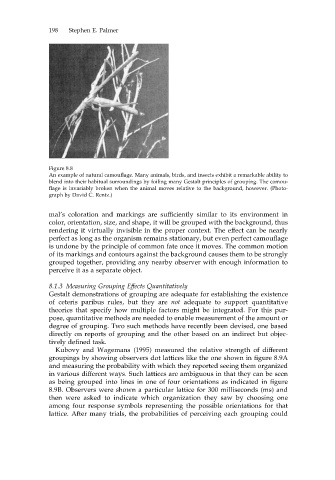
                Figure 8.8
                An example of natural camouflage. Many animals, birds, and insects exhibit a remarkable ability to
                blend into their habitual surroundings by foiling many Gestalt principles of grouping. The camou-
                flage is invariably broken when the animal moves relative to the background, however. (Photo-
                graph by David C. Rentz.)


                mal’s coloration and markings are sufficiently similar to its environment in
                color, orientation, size, and shape, it will be grouped with the background, thus
                rendering it virtually invisible in the proper context. The effect can be nearly
                perfect as long as the organism remains stationary, but even perfect camouflage
                is undone by the principle of common fate once it moves. The common motion
                of its markings and contours against the background causes them to be strongly
                grouped together, providing any nearby observer with enough information to
                perceive it as a separate object.

                8.1.3 Measuring Grouping Effects Quantitatively
                Gestalt demonstrations of grouping are adequate for establishing the existence
                of ceteris paribus rules, but they are not adequate to support quantitative
                theories that specify how multiple factors might be integrated. For this pur-
                pose, quantitative methods are needed to enable measurement of the amount or
                degree of grouping. Two such methods have recently been devised, one based
                directly on reports of grouping and the other based on an indirect but objec-
                tively defined task.
                  Kubovy and Wagemans (1995) measured the relative strength of different
                groupings by showing observers dot lattices like the one shown in figure 8.9A
                and measuring the probability with which they reported seeing them organized
                in various different ways. Such lattices are ambiguous in that they can be seen
                as being grouped into lines in one of four orientations as indicated in figure
                8.9B. Observers were shown a particular lattice for 300 milliseconds (ms) and
                then were asked to indicate which organization they saw by choosing one
                among four response symbols representing the possible orientations for that
                lattice. After many trials, the probabilities of perceiving each grouping could

