


Page 190 - Foundations of Cognitive Psychology : Core Readings
P. 190
194   Stephen E. Palmer


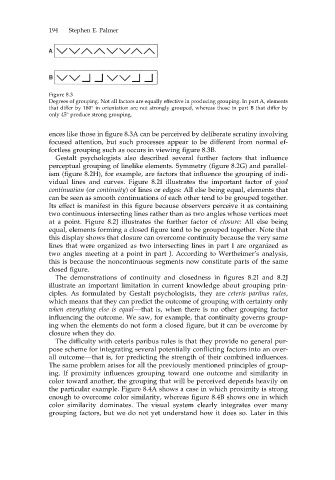
                Figure 8.3
                Degrees of grouping. Not all factors are equally effective in producing grouping. In part A, elements

                that differ by 180 in orientation are not strongly grouped, whereas those in part B that differ by

                only 45 produce strong grouping.
                ences like those in figure 8.3A can be perceived by deliberate scrutiny involving
                focused attention, but such processes appear to be different from normal ef-
                fortless grouping such as occurs in viewing figure 8.3B.
                  Gestalt psychologists also described several further factors that influence
                perceptual grouping of linelike elements. Symmetry (figure 8.2G) and parallel-
                ism (figure 8.2H), for example, are factors that influence the grouping of indi-
                vidual lines and curves. Figure 8.2I illustrates the important factor of good
                continuation (or continuity) of lines or edges: All else being equal, elements that
                can be seen as smooth continuations of each other tend to be grouped together.
                Its effect is manifest in this figure because observers perceive it as containing
                two continuous intersecting lines rather than as two angles whose vertices meet
                at a point. Figure 8.2J illustrates the further factor of closure: All else being
                equal, elements forming a closed figure tend to be grouped together. Note that
                this display shows that closure can overcome continuity because the very same
                lines that were organized as two intersecting lines in part I are organized as
                two angles meeting at a point in part J. According to Wertheimer’s analysis,
                this is because the noncontinuous segments now constitute parts of the same
                closed figure.
                  The demonstrations of continuity and closedness in figures 8.2I and 8.2J
                illustrate an important limitation in current knowledge about grouping prin-
                ciples. As formulated by Gestalt psychologists, they are ceteris paribus rules,
                which means that they can predict the outcome of grouping with certainty only
                when everything else is equal—that is, when there is no other grouping factor
                influencing the outcome. We saw, for example, that continuity governs group-
                ing when the elements do not form a closed figure, but it can be overcome by
                closure when they do.
                  The difficulty with ceteris paribus rules is that they provide no general pur-
                pose scheme for integrating several potentially conflicting factors into an over-
                all outcome—that is, for predicting the strength of their combined influences.
                The same problem arises for all the previously mentioned principles of group-
                ing. If proximity influences grouping toward one outcome and similarity in
                color toward another, the grouping that will be perceived depends heavily on
                the particular example. Figure 8.4A shows a case in which proximity is strong
                enough to overcome color similarity, whereas figure 8.4B shows one in which
                color similarity dominates. The visual system clearly integrates over many
                grouping factors, but we do not yet understand how it does so. Later in this

