


Page 188 - Foundations of Cognitive Psychology : Core Readings
P. 188
192   Stephen E. Palmer

                them to determine which ones caused certain elements to be grouped together
                perceptually.
                  Logically, a set of elements can be partitioned in a number of different ways,
                corresponding to the number of possible ways of dividing them into mutu-
                ally exclusive subsets. This number becomes very large very quickly: For 10
                elements, there are 42 possible groupings; but for 100 elements, there are
                190,569,292. The number of logically possible groupings is even larger than the
                number of partitions if one considers hierarchical embedding of subsets and/or
                overlap among their members. Psychologically, however, only one of these
                groupings is perceived at one time, and the first one is usually the only one.
                How does this happen? And what properties of the stimulus image determine
                which grouping people perceive?

                8.1.1 The Classical Principles of Grouping
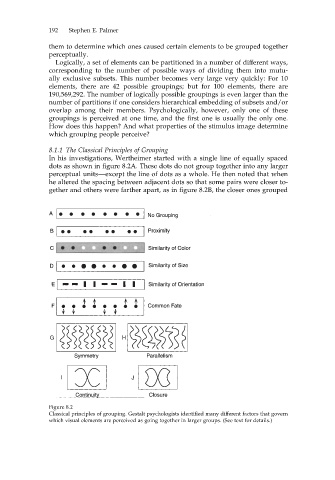
                In his investigations, Wertheimer started with a single line of equally spaced
                dots as shown in figure 8.2A. These dots do not group together into any larger
                perceptual units—except the line of dots as a whole. He then noted that when
                he altered the spacing between adjacent dots so that some pairs were closer to-
                gether and others were farther apart, as in figure 8.2B, the closer ones grouped


                Figure 8.2
                Classical principles of grouping. Gestalt psychologists identified many different factors that govern
                which visual elements are perceived as going together in larger groups. (See text for details.)

