


Page 193 - Foundations of Cognitive Psychology : Core Readings
P. 193
Organizing Objects and Scenes  197


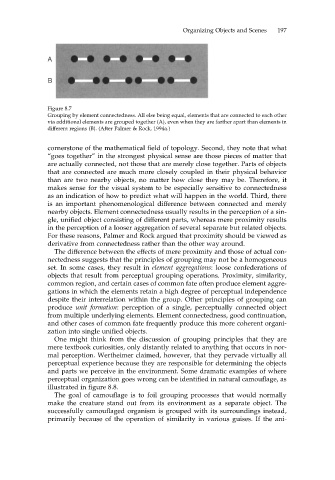
               Figure 8.7
               Grouping by element connectedness. All else being equal, elements that are connected to each other
               via additional elements are grouped together (A), even when they are farther apart than elements in
               different regions (B). (After Palmer & Rock, 1994a.)

               cornerstone of the mathematical field of topology. Second, they note that what
               ‘‘goes together’’ in the strongest physical sense are those pieces of matter that
               are actually connected, not those that are merely close together. Parts of objects
               that are connected are much more closely coupled in their physical behavior
               than are two nearby objects, no matter how close they may be. Therefore, it
               makes sense for the visual system to be especially sensitive to connectedness
               as an indication of how to predict what will happen in the world. Third, there
               is an important phenomenological difference between connected and merely
               nearby objects. Element connectedness usually results in the perception of a sin-
               gle, unified object consisting of different parts, whereas mere proximity results
               in the perception of a looser aggregation of several separate but related objects.
               For these reasons, Palmer and Rock argued that proximity should be viewed as
               derivative from connectedness rather than the other way around.
                 The difference between the effects of mere proximity and those of actual con-
               nectedness suggests that the principles of grouping may not be a homogeneous
               set. In some cases, they result in element aggregations: loose confederations of
               objects that result from perceptual grouping operations. Proximity, similarity,
               common region, and certain cases of common fate often produce element aggre-
               gations in which the elements retain a high degree of perceptual independence
               despite their interrelation within the group. Other principles of grouping can
               produce unit formation: perception of a single, perceptually connected object
               from multiple underlying elements. Element connectedness, good continuation,
               and other cases of common fate frequently produce this more coherent organi-
               zation into single unified objects.
                 One might think from the discussion of grouping principles that they are
               mere textbook curiosities, only distantly related to anything that occurs in nor-
               mal perception. Wertheimer claimed, however, that they pervade virtually all
               perceptual experience because they are responsible for determining the objects
               and parts we perceive in the environment. Some dramatic examples of where
               perceptual organization goes wrong can be identified in natural camouflage, as
               illustrated in figure 8.8.
                 The goal of camouflage is to foil grouping processes that would normally
               make the creature stand out from its environment as a separate object. The
               successfully camouflaged organism is grouped with its surroundings instead,
               primarily because of the operation of similarity in various guises. If the ani-

