


Page 196 - Foundations of Cognitive Psychology : Core Readings
P. 196
200   Stephen E. Palmer


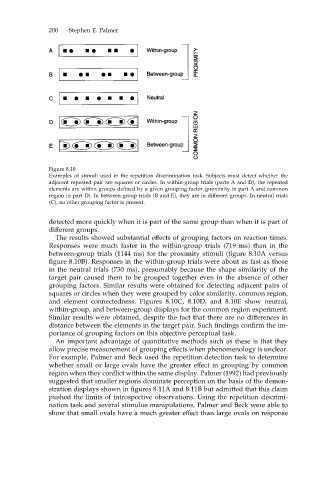
                Figure 8.10
                Examples of stimuli used in the repetition discrimination task. Subjects must detect whether the
                adjacent repeated pair are squares or circles. In within-group trials (parts A and D), the repeated
                elements are within groups defined by a given grouping factor (proximity in part A and common
                region in part D). In between-group trials (B and E), they are in different groups. In neutral trials
                (C), no other grouping factor is present.

                detected more quicklywhenitispartofthe same groupthanwhenitispartof
                different groups.
                  The results showed substantial effects of grouping factors on reaction times.
                Responses were much faster in the within-group trials (719 ms) than in the
                between-group trials (1144 ms) for the proximity stimuli (figure 8.10A versus
                figure 8.10B). Responses in the within-group trials were about as fast as those
                in the neutral trials (730 ms), presumably because the shape similarity of the
                target pair caused them to be grouped together even in the absence of other
                grouping factors. Similar results were obtained for detecting adjacent pairs of
                squares or circles when they were grouped by color similarity, common region,
                and element connectedness. Figures 8.10C, 8.10D, and 8.10E show neutral,
                within-group, and between-group displays for the common region experiment.
                Similar results were obtained, despite the fact that there are no differences in
                distance between the elements in the target pair. Such findings confirm the im-
                portance of grouping factors on this objective perceptual task.
                  An important advantage of quantitative methods such as these is that they
                allow precise measurement of grouping effects when phenomenology is unclear.
                For example, Palmer and Beck used the repetition detection task to determine
                whether small or large ovals have the greater effect in grouping by common
                region when they conflict within the same display. Palmer (1992) had previously
                suggested that smaller regions dominate perception on the basis of the demon-
                stration displays shown in figures 8.11A and 8.11B but admitted that this claim
                pushed the limits of introspective observations. Using the repetition discrimi-
                nation task and several stimulus manipulations, Palmer and Beck were able to
                show that small ovals have a much greater effect than large ovals on response

