


Page 201 - Foundations of Cognitive Psychology : Core Readings
P. 201
Organizing Objects and Scenes  205


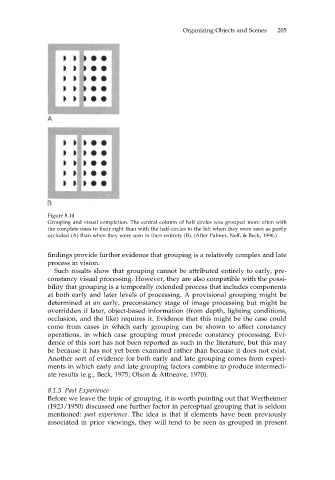
               Figure 8.14
               Grouping and visual completion. The central column of half circles was grouped more often with
               the complete ones to their right than with the half-circles to the left when they were seen as partly
               occluded (A) than when they were seen in their entirety (B). (After Palmer, Neff, & Beck, 1996.)

               findings provide further evidence that grouping is a relatively complex and late
               process in vision.
                 Such results show that grouping cannot be attributed entirely to early, pre-
               constancy visual processing. However, they are also compatible with the possi-
               bility that grouping is a temporally extended process that includes components
               at both early and later levels of processing. A provisional grouping might be
               determined at an early, preconstancy stage of image processing but might be
               overridden if later, object-based information (from depth, lighting conditions,
               occlusion, and the like) requires it. Evidence that this might be the case could
               come from cases in which early grouping can be shown to affect constancy
               operations, in which case grouping must precede constancy processing. Evi-
               dence of this sort has not been reported as such in the literature, but this may
               be because it has not yet been examined rather than because it does not exist.
               Another sort of evidence for both early and late grouping comes from experi-
               ments in which early and late grouping factors combine to produce intermedi-
               ate results (e.g., Beck, 1975; Olson & Attneave, 1970).

               8.1.5 Past Experience
               Before we leave the topic of grouping, it is worth pointing out that Wertheimer
               (1923/1950) discussed one further factor in perceptual grouping that is seldom
               mentioned: past experience. The idea is that if elements have been previously
               associated in prior viewings, they will tend to be seen as grouped in present

