


Page 206 - Foundations of Cognitive Psychology : Core Readings
P. 206
210   Stephen E. Palmer


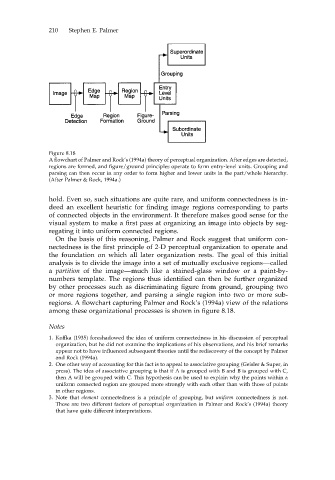
                Figure 8.18
                A flowchart of Palmer and Rock’s (1994a) theory of perceptual organization. After edges are detected,
                regions are formed, and figure/ground principles operate to form entry-level units. Grouping and
                parsingcan then occurinany ordertoformhigherand lowerunits in thepart/wholehierarchy.
                (After Palmer & Rock, 1994a.)


                hold. Even so, such situations are quite rare, and uniform connectedness is in-
                deed an excellent heuristic for finding image regions corresponding to parts
                of connected objects in the environment. It therefore makes good sense for the
                visual system to make a first pass at organizing an image into objects by seg-
                regating it into uniform connected regions.
                  On the basis of this reasoning, Palmer and Rock suggest that uniform con-
                nectedness is the first principle of 2-D perceptual organization to operate and
                the foundation on which all later organization rests. The goal of this initial
                analysis is to divide the image into a set of mutually exclusive regions—called
                a partition of the image—much like a stained-glass window or a paint-by-
                numbers template. The regions thus identified can then be further organized
                by other processes such as discriminating figure from ground, grouping two
                or more regions together, and parsing a single region into two or more sub-
                regions. A flowchart capturing Palmer and Rock’s (1994a) view of the relations
                among these organizational processes is shown in figure 8.18.

                Notes
                1. Koffka (1935) foreshadowed the idea of uniform connectedness in his discussion of perceptual
                  organization, but he did not examine the implications of his observations, and his brief remarks
                  appear not to have influenced subsequent theories until the rediscovery of the concept by Palmer
                  and Rock (1994a).
                2. One other way of accounting for this fact is to appeal to associative grouping (Geisler & Super, in
                  press). The idea of associative grouping is that if A is grouped with B and B is grouped with C,
                  then A will be grouped with C. This hypothesis can be used to explain why the points within a
                  uniform connected region are grouped more strongly with each other than with those of points
                  in other regions.
                3. Note that element connectedness is a principle of grouping, but uniform connectedness is not.
                  These are two different factors of perceptual organization in Palmer and Rock’s (1994a) theory
                  that have quite different interpretations.

