


Page 202 - Foundations of Cognitive Psychology : Core Readings
P. 202
206   Stephen E. Palmer


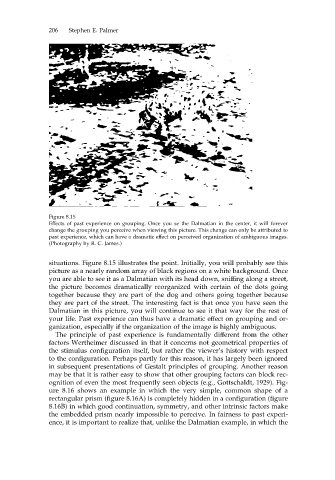
                Figure 8.15
                Effects of past experience on grouping. Once you se the Dalmatian in the center, it will forever
                change the grouping you perceive when viewing this picture. This change can only be attributed to
                past experience, which can have a dramatic effect on perceived organization of ambiguous images.
                (Photography by R. C. James.)


                situations. Figure 8.15 illustrates the point. Initially, you will probably see this
                picture as a nearly random array of black regions on a white background. Once
                you are able to see it as a Dalmatian with its head down, sniffing along a street,
                the picture becomes dramatically reorganized with certain of the dots going
                together because they are part of the dog and others going together because
                they are part of the street. The interesting fact is that once you have seen the
                Dalmatian in this picture, you will continue to see it that way for the rest of
                your life. Past experience can thus have a dramatic effect on grouping and or-
                ganization, especially if the organization of the image is highly ambiguous.
                  The principle of past experience is fundamentally different from the other
                factors Wertheimer discussed in that it concerns not geometrical properties of
                the stimulus configuration itself, but rather the viewer’s history with respect
                to the configuration. Perhaps partly for this reason, it has largely been ignored
                in subsequent presentations of Gestalt principles of grouping. Another reason
                may be that it is rather easy to show that other grouping factors can block rec-
                ognition of even the most frequently seen objects (e.g., Gottschaldt, 1929). Fig-
                ure8.16shows an exampleinwhich theverysimple, common shapeofa
                rectangular prism (figure 8.16A) is completely hidden in a configuration (figure
                8.16B) in which good continuation, symmetry, and other intrinsic factors make
                the embedded prism nearly impossible to perceive. In fairness to past experi-
                ence, it is important to realize that, unlike the Dalmatian example, in which the

